Bienvenue sur le site de Patrice Aguilar


The Ultimate Guide to Photographing the White Horses of the Camargue
which guarantees you’ll successfully capture great photos of Camargue horses every time
Everything you need to know about photographing one of the world's most iconic horse breeds in the south of France
Best locations, camera settings, light, behavior, ethics and exclusive field experience.
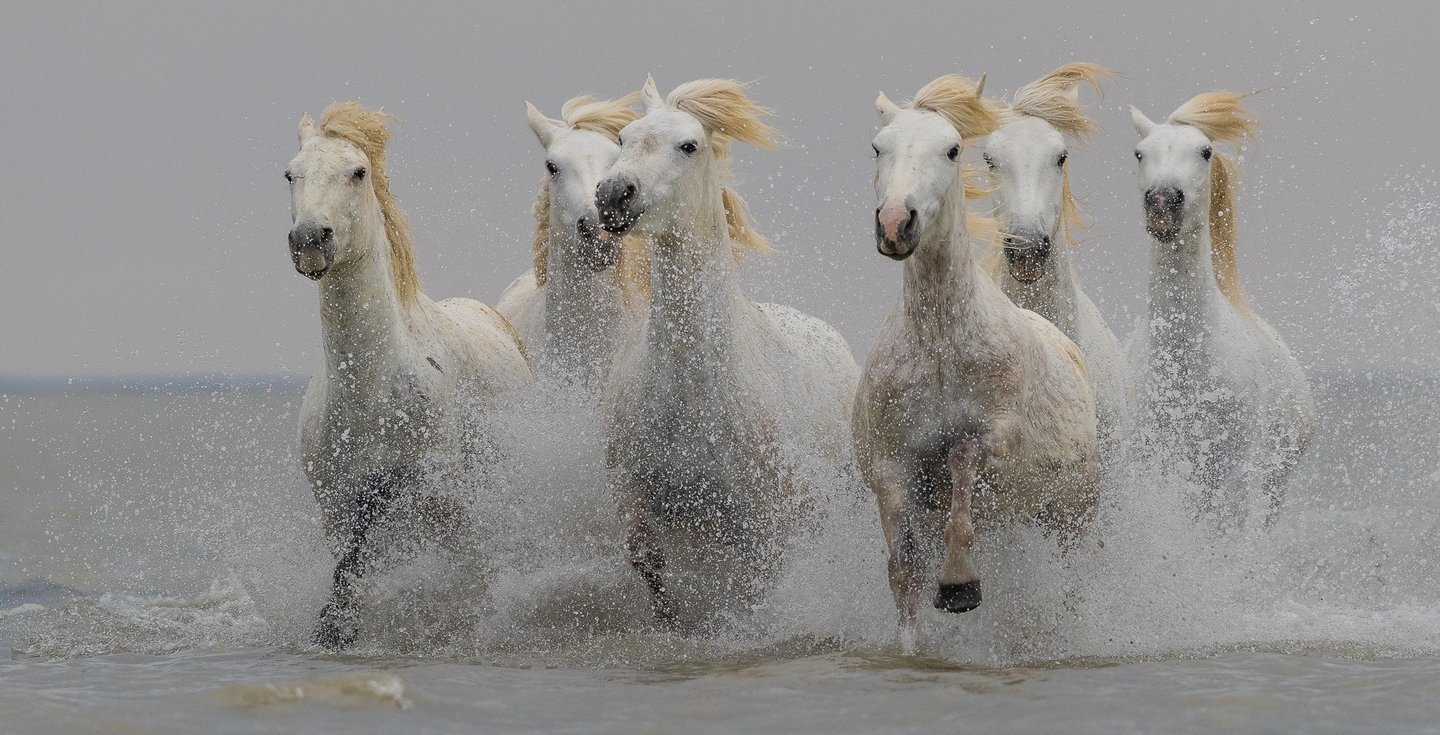
Before sunrise, nature begins to awaken. The only sounds are the songs of birds echoing across the pond.
A delicate mist drifts over the water as we wait in silence for a truly unforgettable spectacle.
Then, somewhere in the distance, we hear it.
The sound of hooves.
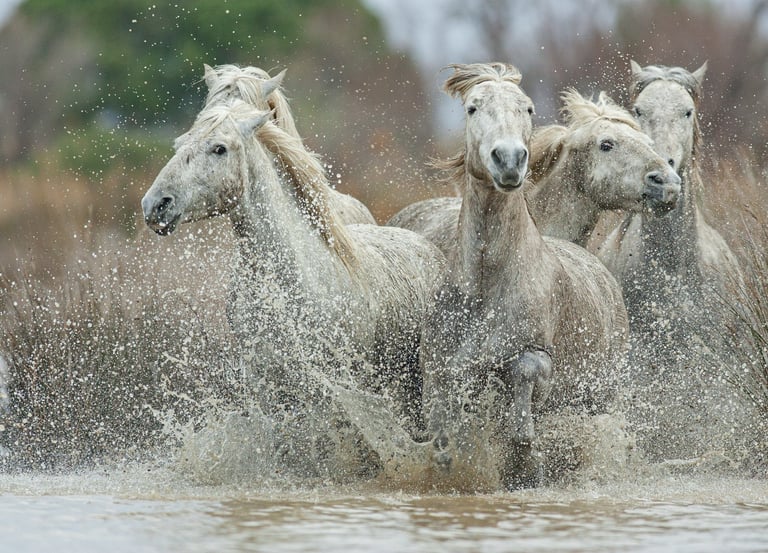
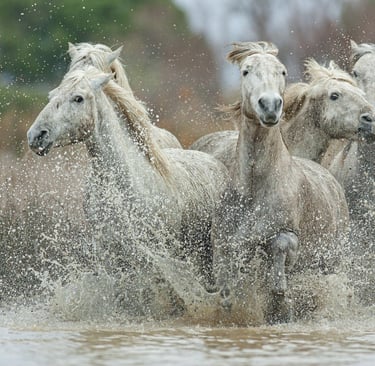
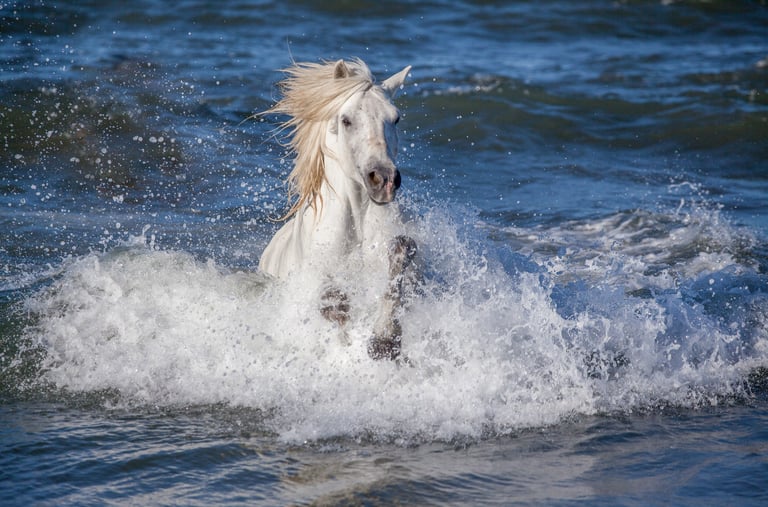
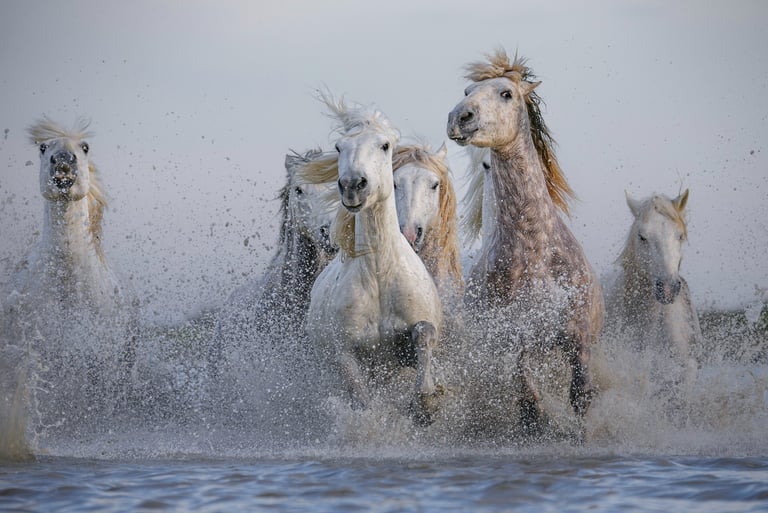
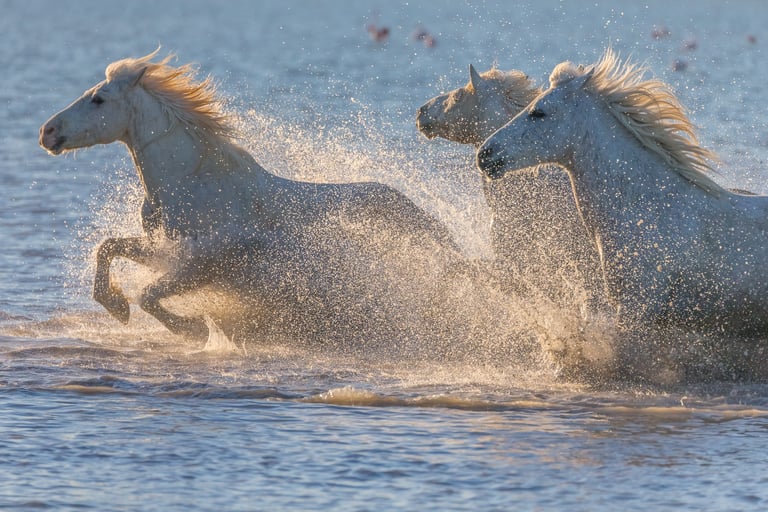
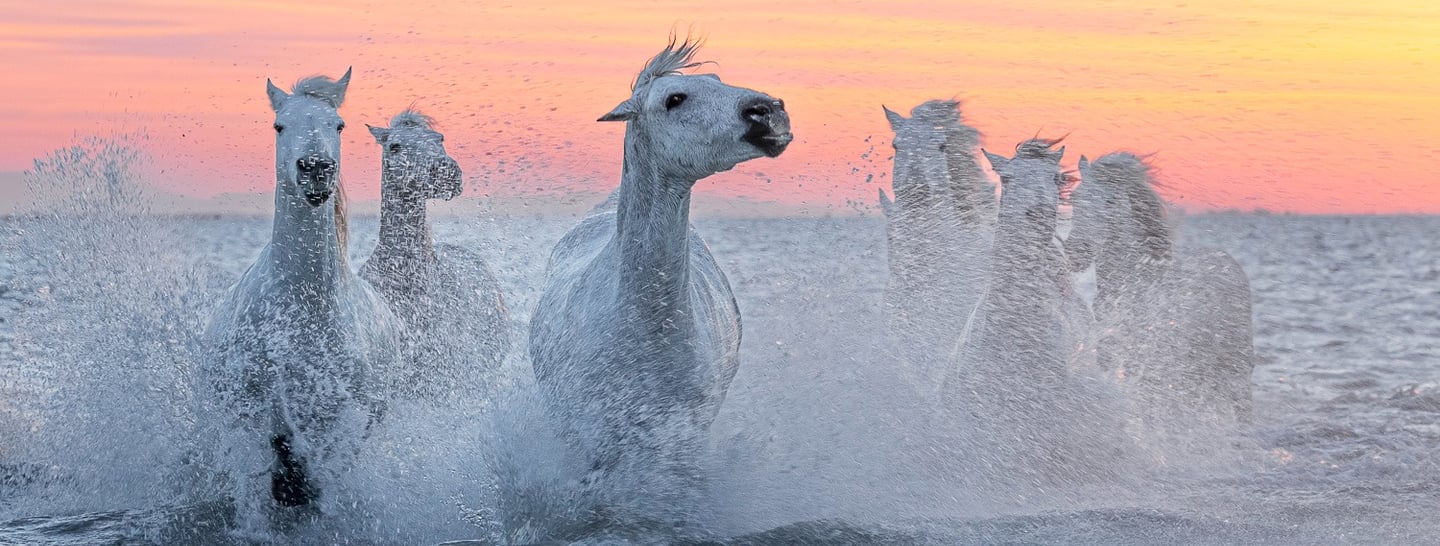
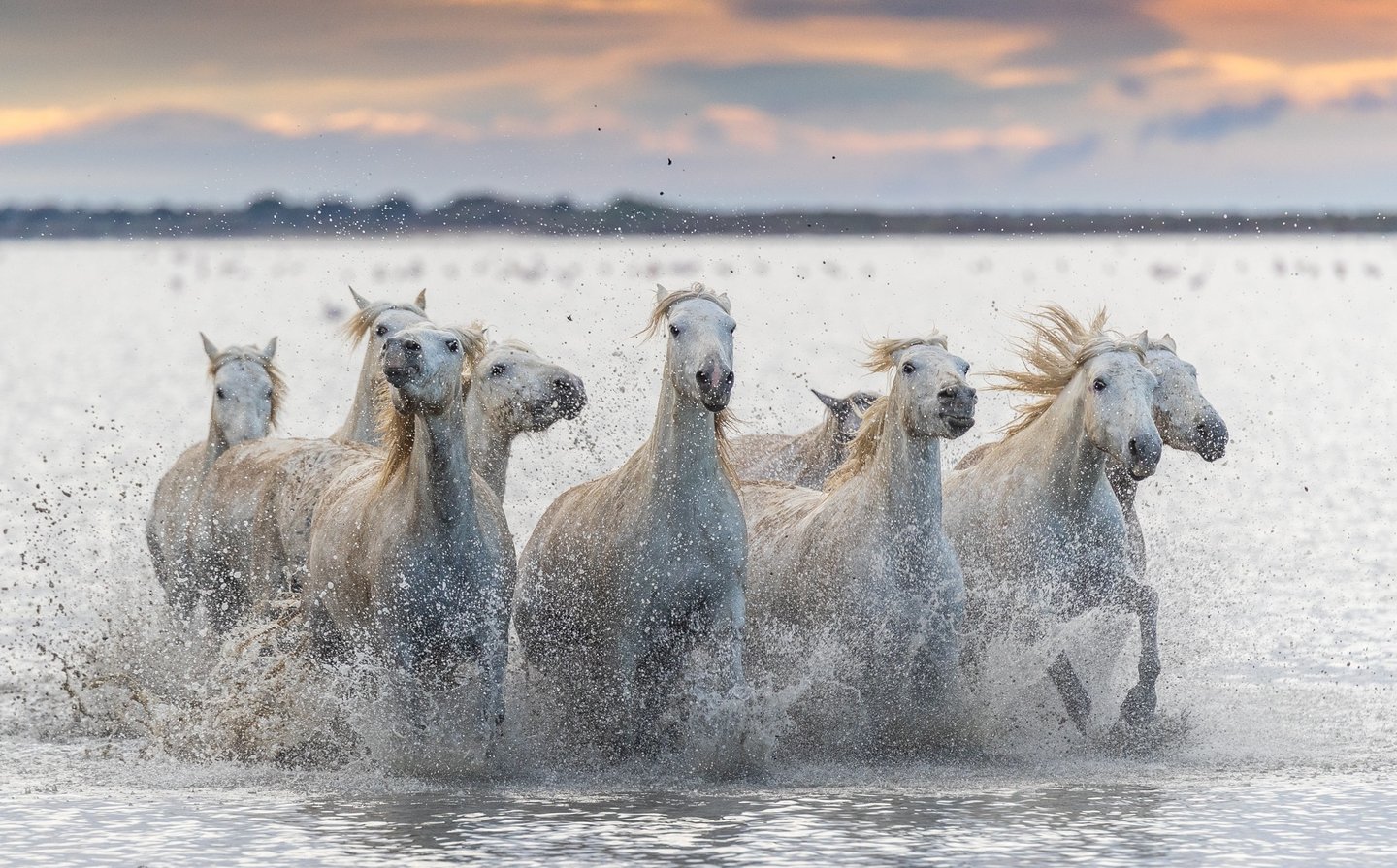
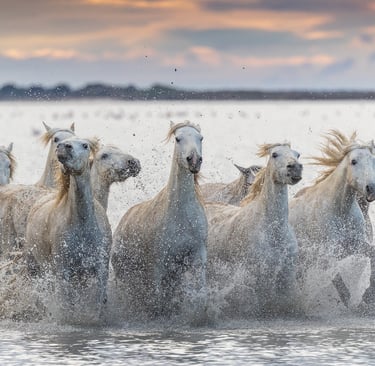
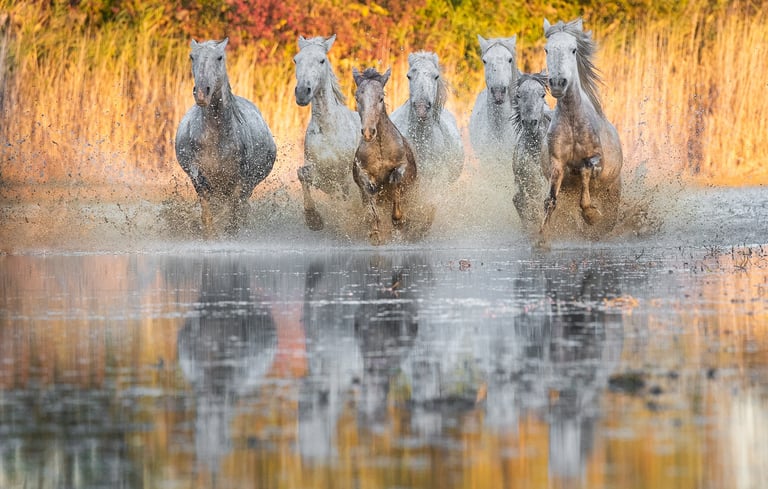
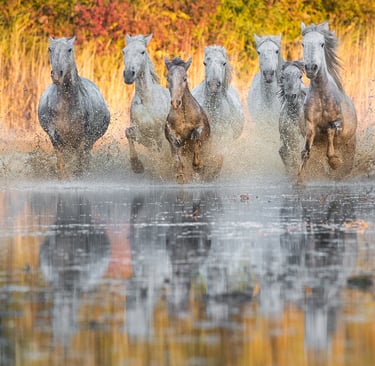
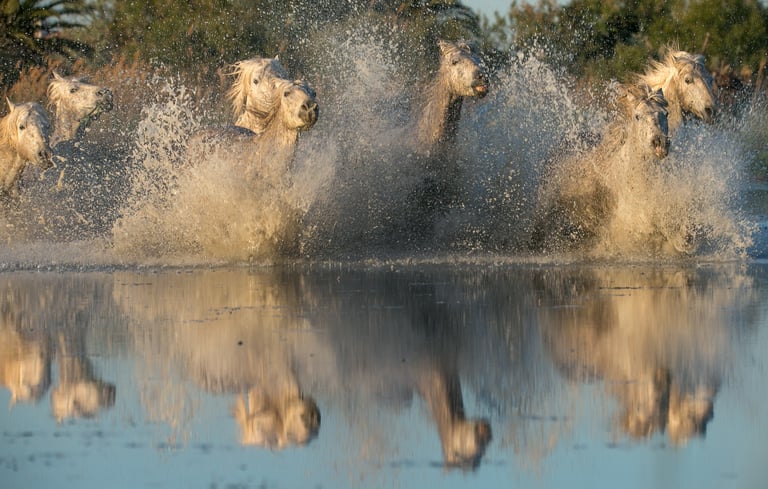
Moments later, a herd of magnificent white horses bursts through the water, illuminated by the first golden rays of dawn. Water explodes beneath their powerful strides as the rising sun paints the landscape in warm, golden light.
This is more than horse photography, more than a simple Camargue photography workshop.
It is one of Europe's most breathtaking wildlife photography experiences, an encounter with the untamed spirit of the Camargue that few photographers will ever forget.
Discover the Wild White Horses of Camargue, Southern France
Majestic, free, and bathed in the golden light of the marshes, the white horses of the Camargue are among Europe's most iconic animals.
The Camargue horse history is fascinating. For centuries, they have roamed the vast wilderness of the Rhône Delta, moving between lagoons, salt marshes, reed beds, and fine sandy beaches. They have thus adapted remarkably well to the unique, and sometimes very harsh, environment of the Camargue : fierce winds, summer heat, mosquitoes, and marshes.
Considered one of Europe's oldest horse breeds, the Camargue horse is perfectly adapted to its environment. Hardy, agile, and possessing remarkable stamina, it lives in a semi-wild state year-round within herds known as manades, raised according to ancestral traditions by the gardians, the famous horsemen of the Camargue.
Yet, what is perhaps most fascinating is their immaculate coat. Interestingly, these horses are born with a dark coat, ranging from dark grey to black, before gradually turning white over the years. This transformation adds to their almost mythical aura and explains why they are now one of the Camargue's most recognizable symbols.
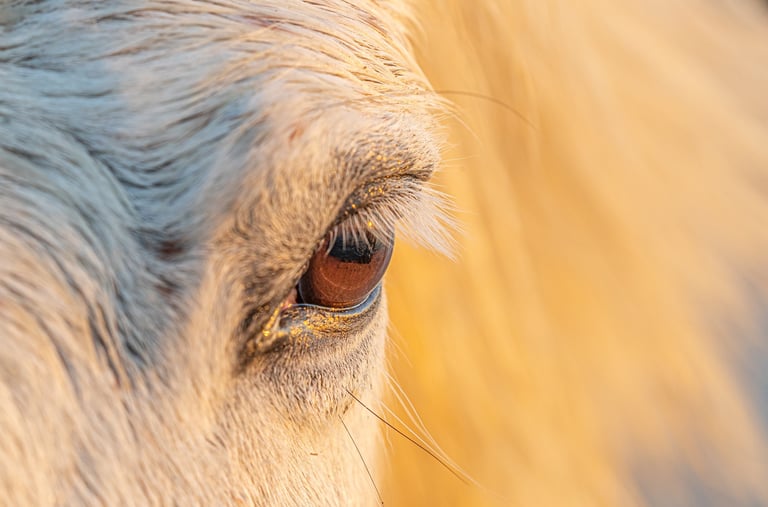
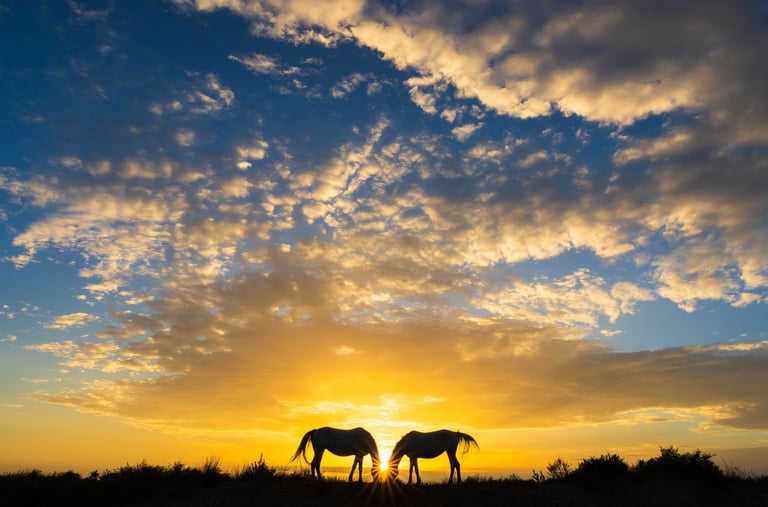
Far more than just an equine breed, the Camargue horse embodies a true living heritage. It is deeply intertwined with the cultural identity of southern France, having accompanied gardians for generations as they herd bulls. Their elegant silhouettes, whether traversing the marshes or galloping through the surf, have become iconic images that draw thousands of nature, photography, and travel enthusiasts every year.
For photographers heading to the Camargue with high ambitions for equine photography, the white horses of the Camargue offer an exceptional subject. Their power, elegance, and freedom, combined with the spectacular light of sunrises and sunsets, create scenes of rare intensity.
Watching a herd emerge from the water amidst a cloud of spray is an unforgettable experience, one that leaves a lasting impression on any wildlife photography lover. Today, Camargue horses are far more than a regional emblem : they embody the wild, authentic spirit of Provence and are among the most sought-after subjects for photographers worldwide.
The Unique Genetics : Why Camargue Horses Are White
Camargue horses are renowned for their magnificent white coats, which contrast with the wild landscapes of the marshes in southern France. However, this pristine color is not present at birth.
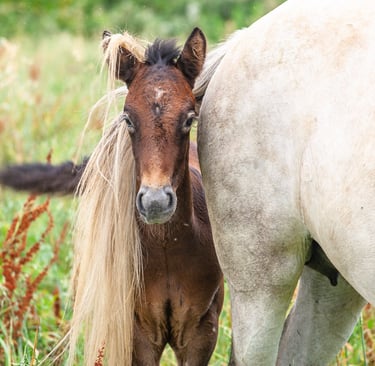
In reality, Camargue foals are born with dark coats, typically black, bay, or dark brown, and undergo a process of gradual depigmentation over the years. This fascinating phenomenon is explained by a specific genetic mechanism linked to the "gray gene."
The white color of adult Camargue horses is not due to a white-color gene, but rather to the action of a graying gene. This gene, scientifically identified as the STX17 (Syntaxin-17) gene located on chromosome 25, acts as a modifier gene on the horse's base coat color.
The cellular mechanism of graying
The graying process is linked to the behavior of melanocytes, the cells responsible for producing melanin (the pigment that colors skin and hair).
The mutation found in the STX17 gene causes hyper-stimulation of melanocytes during the foal's early years. This overactivity explains why gray foals are often born with a darker, more saturated coat than non-gray foals.
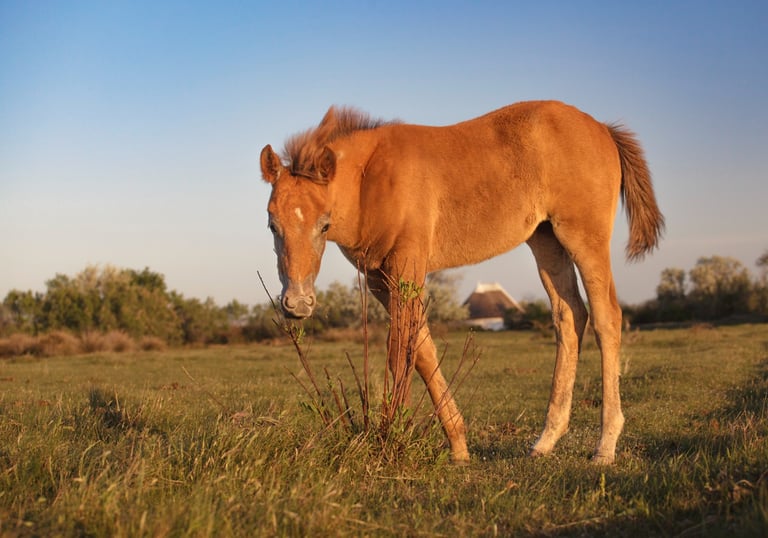
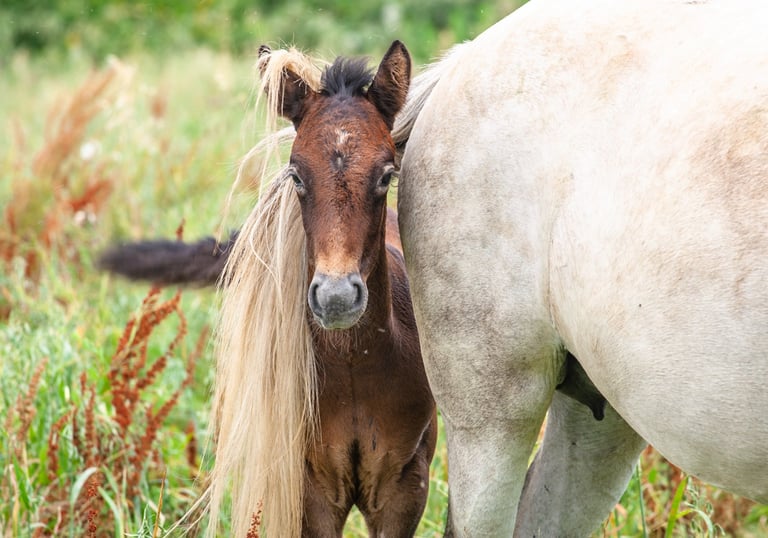
However, this excessive proliferation comes at a cost: it prematurely depletes the pool of melanocyte stem cells located at the base of the hair follicles. As the horse molts and renews its coat, new hairs grow without pigment because the melanocytes are no longer able to produce melanin. Consequently, the hair turns white.
A genetic trait with significant consequences
While this process gives Camargue horses their iconic appearance, it is also linked to a medical predisposition. The hyper-proliferation of melanocytes induced by the STX17 gene significantly increases the risk of developing melanomas (skin tumors).
Studies show that approximately 70% to 80% of grey horses over the age of 15 develop melanomas; these are usually benign but can sometimes become malignant.
Conclusion
The progressive whitening of Camargue horses is a magnificent example of evolutionary genetics. It is not a magical color change linked to the saline environment of the Camargue, but rather the expression of an ancient genetic mutation (the STX17 gene). This mutation causes the premature depletion of pigment cells, transforming a foal as black as night into a horse as white as sea foam.
Camargue Horses : Masters of Adaptation in a Unique Ecosystem
The Camargue horse is a renowned for its ability to thrive in the harsh and unique conditions of its natural habitat : the salt marshes of the Rhône Delta. Over the centuries, rigorous natural selection has shaped these horses, endowing them with remarkable morphological, physiological, and behavioral adaptations that enable them to survive and flourish in this demanding ecosystem.
Morphological and physical adaptations
The morphology of the Camargue horse is perfectly adapted to its wet and sometimes inhospitable environment :
Broad, tough hooves : One of the most distinctive adaptations is the size and sturdiness of their hooves. Broad and flared, they provide better flotation and excellent traction on the soft, muddy, and waterlogged ground of the marshes, preventing the horse from sinking in. This feature is so pronounced that they generally do not require horseshoes.
Compact, sturdy body : The Camargue is a medium-sized horse (approximately 1.35 to 1.45 m at the withers) with a compact body, short, sturdy legs, and powerful musculature. This build gives them great agility and exceptional endurance, qualities essential for navigating varied and sometimes difficult terrain. Their low-set shoulders and sturdy legs make them highly agile, capable of making tight turns even at a gallop.
Dense, water-resistant coat : While their grey coat (which turns white with age as you know now) is their best-known feature, their fur is also dense and water-resistant. This thick coat effectively protects them from the cold, dampness, and strong winds that can sweep across the Camargue, even in winter.
Resistance to insects : Their skin texture and the density of their thick manes and tails help protect them against insect bites, as insects are particularly abundant in these wetland areas.
Physiological and behavioral adaptations
Beyond their physical characteristics, Camargue horses have developed physiological and behavioral traits that optimize their survival :
Frugal and varied diet : Camargue horses are renowned for their hardiness and ability to thrive on little. They can subsist on vegetation that other equines find unpalatable, such as reeds, marsh grasses, and halophytes (salt-tolerant plants). This ability to utilize poor-quality vegetation is crucial in an environment where lush pastures are scarce.
Thermoregulation : They adapt perfectly to Mediterranean climatic extremes, withstanding both intense summer heat and the biting cold and dampness of winter. Their ability to live outdoors year-round, often with their hooves standing in water, demonstrates their excellent thermoregulation.
Hardiness and resilience : Raised in a semi-wild state within manades (herds), Camargue horses develop great self-reliance, intelligence, and an independent temperament. They learn to forage, shelter themselves from the elements, and interact within their group, all of which strengthens their resilience in the face of environmental challenges.
Calm and loyal temperament : Despite their independence, they are known for their calm nature and loyalty once tamed. These qualities have made them essential partners for gardians (herdsmen), who rely on them to manage livestock in the marshes.
The Camargue horse is a striking example of successful adaptation to a specific environment. Every aspect of the animal, from its sturdy hooves and protective coat to its diet and social behavior, is the result of a long co-evolution with the Camargue marshes. This resilience makes the horse not only a powerful cultural symbol of the region but also a key ecological player in preserving wetland biodiversity.
Symbolism of the Camargue Horse : Freedom, Tradition & Artistic Inspiration
The Camargue horse, with its iconic white coat and wild bearing, is far more than just a breed of horse; it is a true cultural icon, deeply rooted in the identity of Provence and the Camargue. A symbol of freedom, strength, and resilience, it embodies the untamed spirit of its homeland and has long inspired artists and writers.
Freedom and Strength : The Wild Spirit of the Marshes
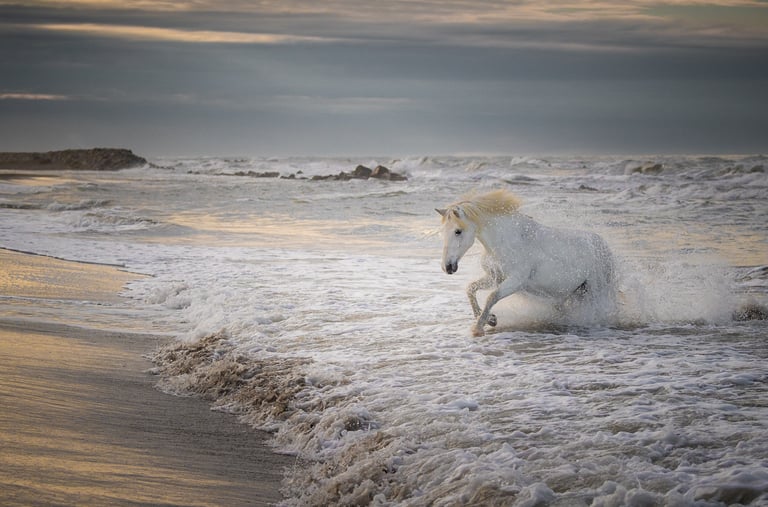
The Camargue horse is, above all, a symbol of freedom. Raised in a semi-wild state across the vast expanses of marshes and salt flats, it gallops with its mane flowing in the wind along beaches and through reed beds, presenting a powerful image of wild, unspoiled nature. This open-air existence, shaped by the elements, endows the horse with exceptional strength and endurance, enabling it to adapt to the harsh conditions of its environment.
It is often described as possessing a "fierce spirit" and an "independent nature", traits that reflect its wild ancestry and its ability to survive without constant human intervention. This self-reliance and hardiness are qualities admired and celebrated by the region's inhabitants.
Camargue Traditions and the Role of the Gardians
The Camargue horse is inseparable from Camargue traditions and the iconic figure of the gardian. These horsemen, true "knights of the delta", watch over herds of semi-wild bulls, relying on the horse as both an indispensable working tool and a faithful companion.
The bond between the gardian and his horse is profound, rooted in trust and mutual understanding. A local saying holds that these horses "do not obey; they understand." Together, they take part in ferrades (hot-iron branding of foals), abrivados and bandidos (herding bulls through village streets), and other popular festivals that shape the rhythm of life in the Camargue. These events are living expressions of a culture passed down through generations, with the horse at the heart of the action and local identity.
Provençal Culture : A Living Heritage
The Camargue horse is a cornerstone of Provençal culture, representing a heritage that spans millennia. Its presence in the region dates back to Roman times, and it is considered one of the oldest horse breeds in the world. It embodies the pride of a people deeply attached to their roots and traditional way of life. Official recognition of the breed in 1978 helped preserve its purity and its role within the cultural and ecological landscape of the Camargue.
It is often associated with other symbols of the Camargue, such as the bull and the pink flamingo, forming a triad that represents the soul of this wild and authentic land.
Artistic Inspiration : From the movie "Crin-Blanc" to Modern Art
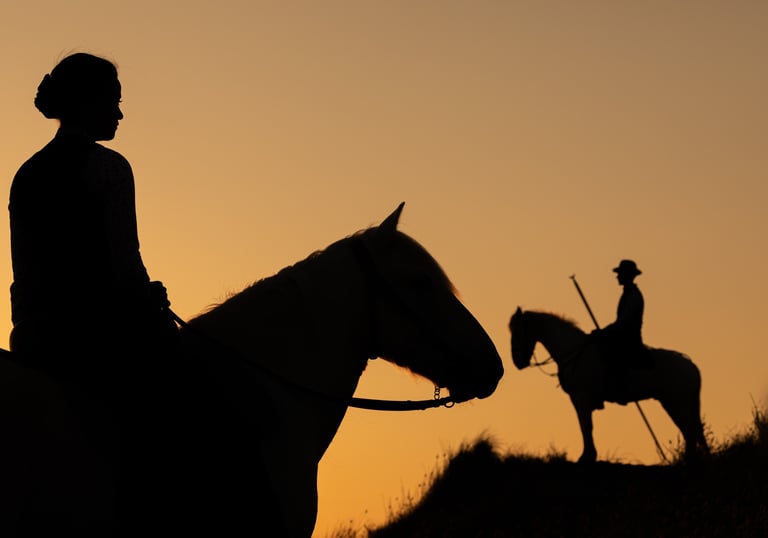
The beauty and spirit of the Camargue horse have long been a major source of artistic inspiration. Its white coat, contrasting with the dark waters of the marshes and the azure sky, makes it a favorite subject for photographers, painters, and filmmakers.
The most famous work inspired by the Camargue horse is undoubtedly Albert Lamorisse’s 1953 film and book, Crin-Blanc (White Mane). This poetic tale portrays the unwavering friendship between a young fisherman, Folco, and a wild stallion, Crin-Blanc, who is too proud to be tamed by humans. The film immortalized the image of the Camargue horse as a symbol of indomitable freedom and purity, contributing to its worldwide renown.
Beyond Crin-Blanc, the Camargue horse continues to inspire numerous artists, writers, and poets, who see in it the embodiment of wild beauty, resilience, and the harmony between humanity and nature. It is celebrated in literature, painting, sculpture, and photography, a testament to its enduring impact on the collective imagination.
Camargue : A Premier Wildlife & Horse Photography Destination in France
The Camargue, a vast wilderness located in the Rhône delta, is world-renowned as an exceptional setting for equestrian photography. This privileged status stems from a unique combination of spectacular landscapes, incomparable light, iconic wildlife, and deeply rooted human traditions.
The incomparable light of the south of France
The light in the Camargue is one of its greatest assets. The vast, often clear sky, combined with the omnipresence of water, creates exceptional lighting conditions. Photographers are particularly drawn to :
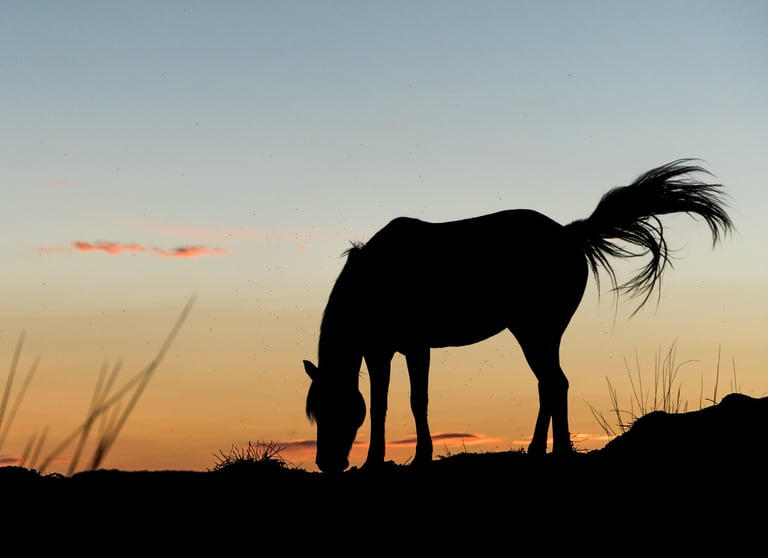
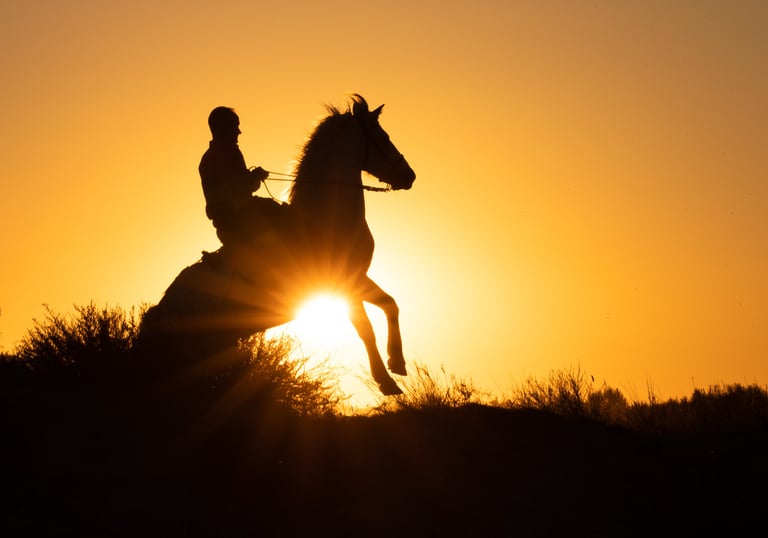
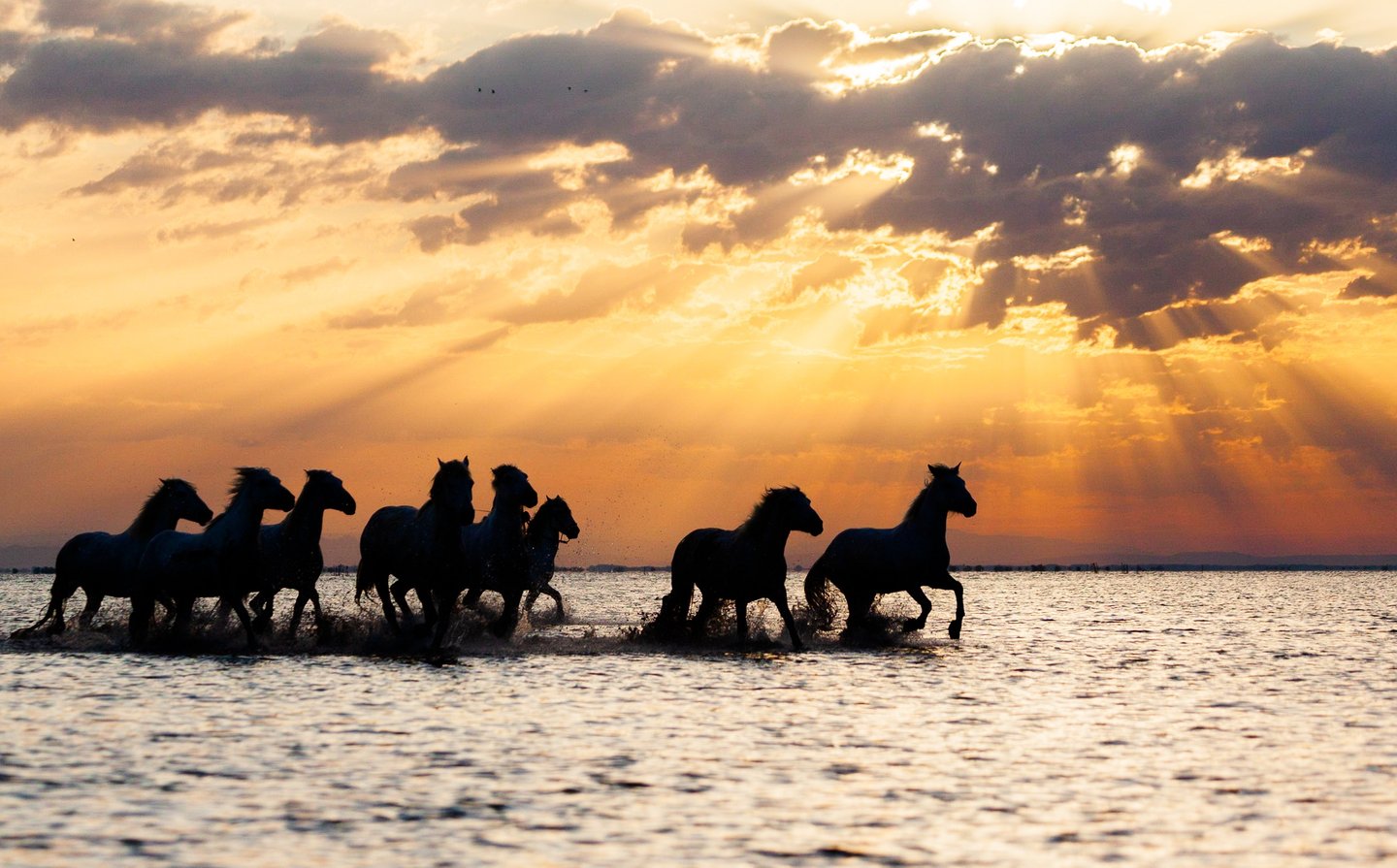
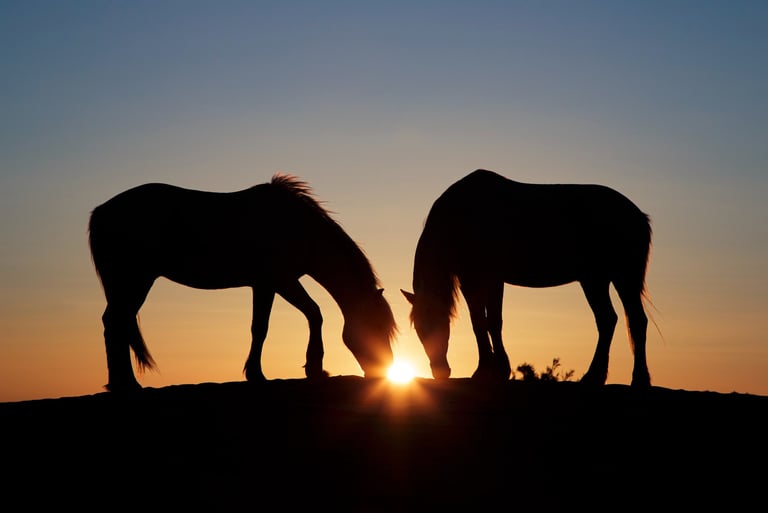
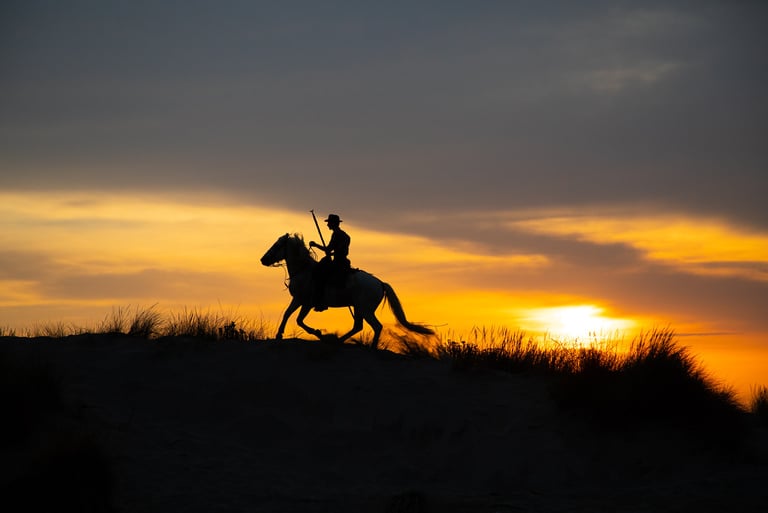
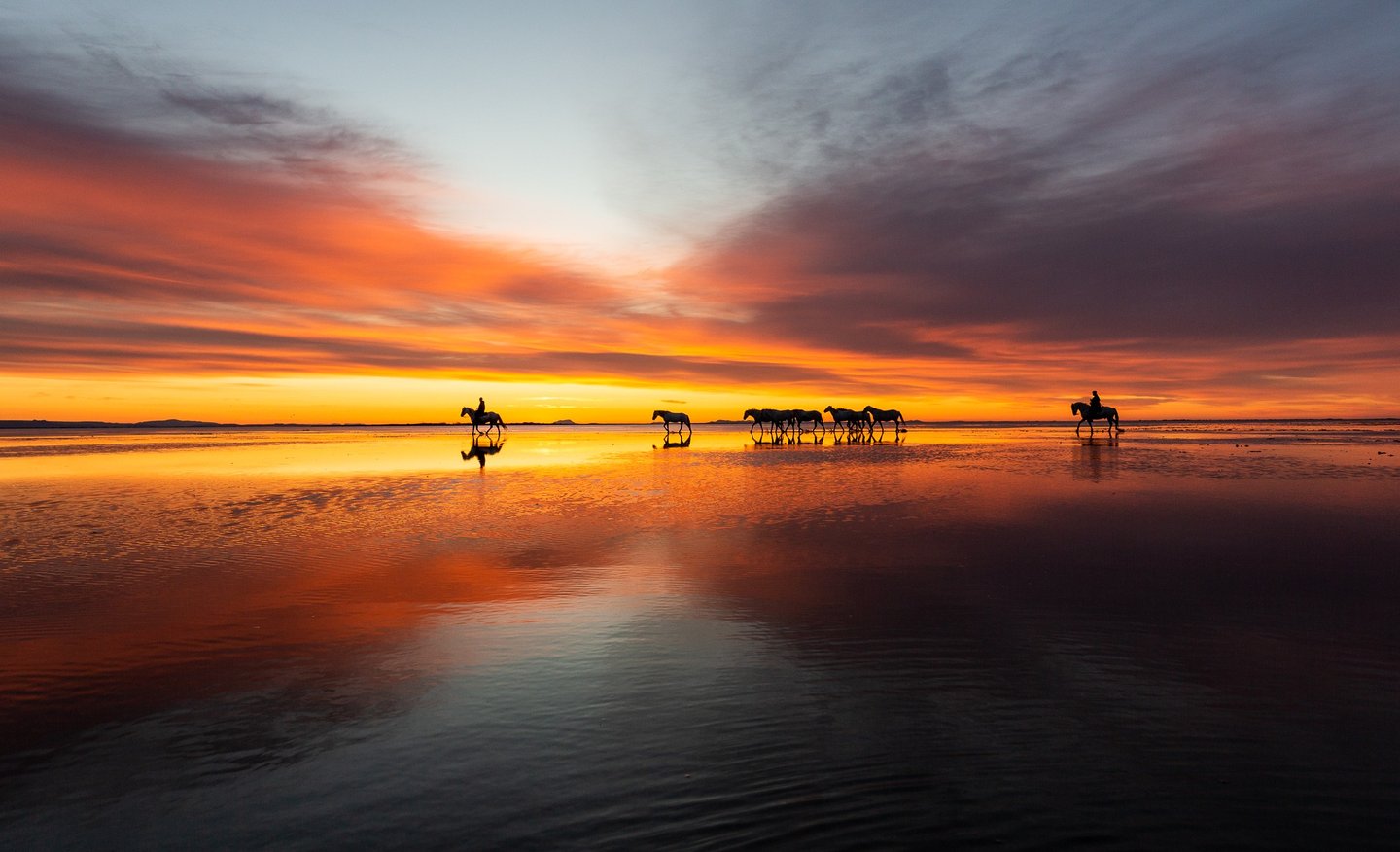
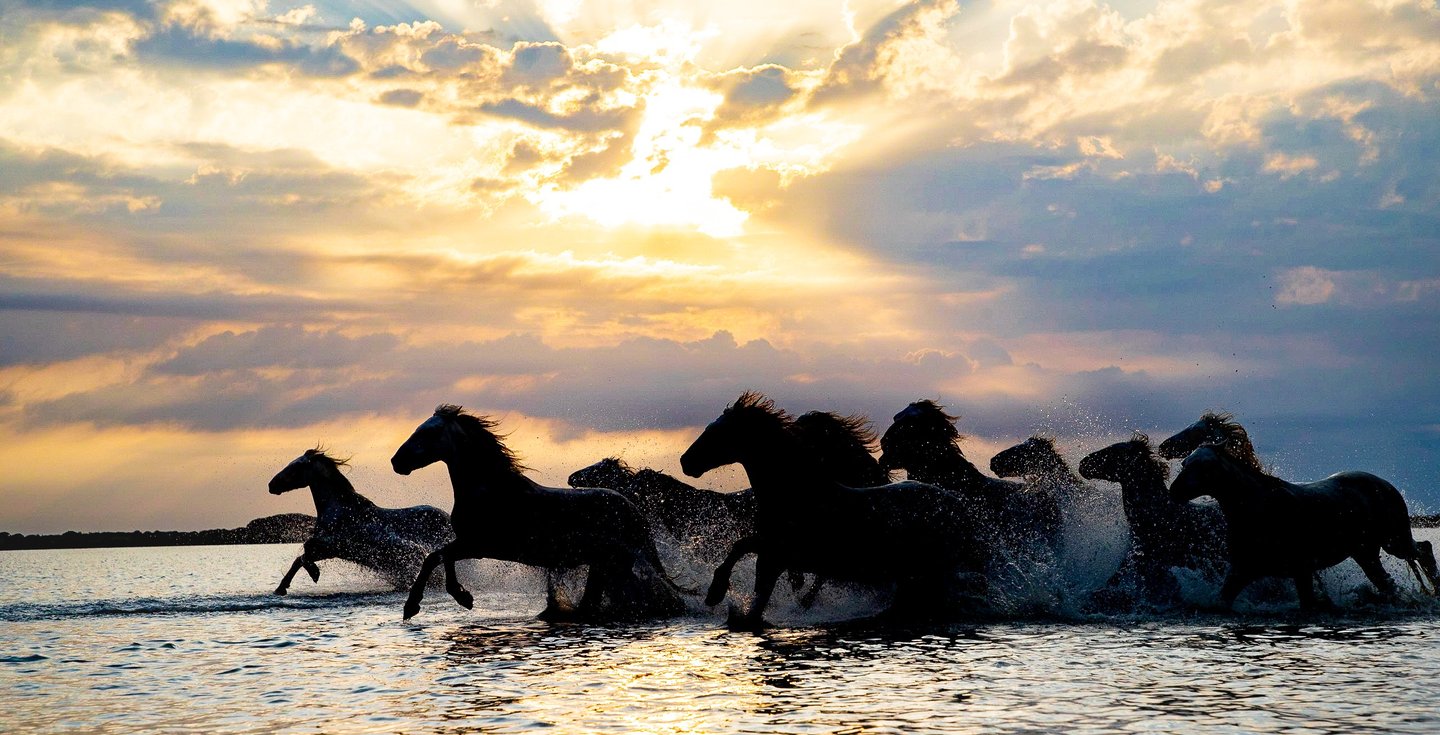
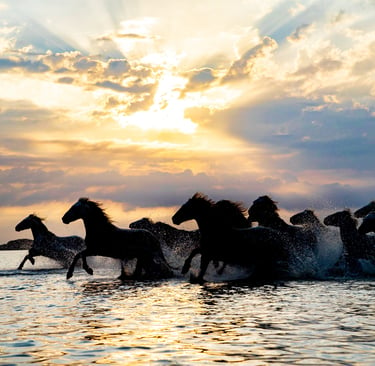
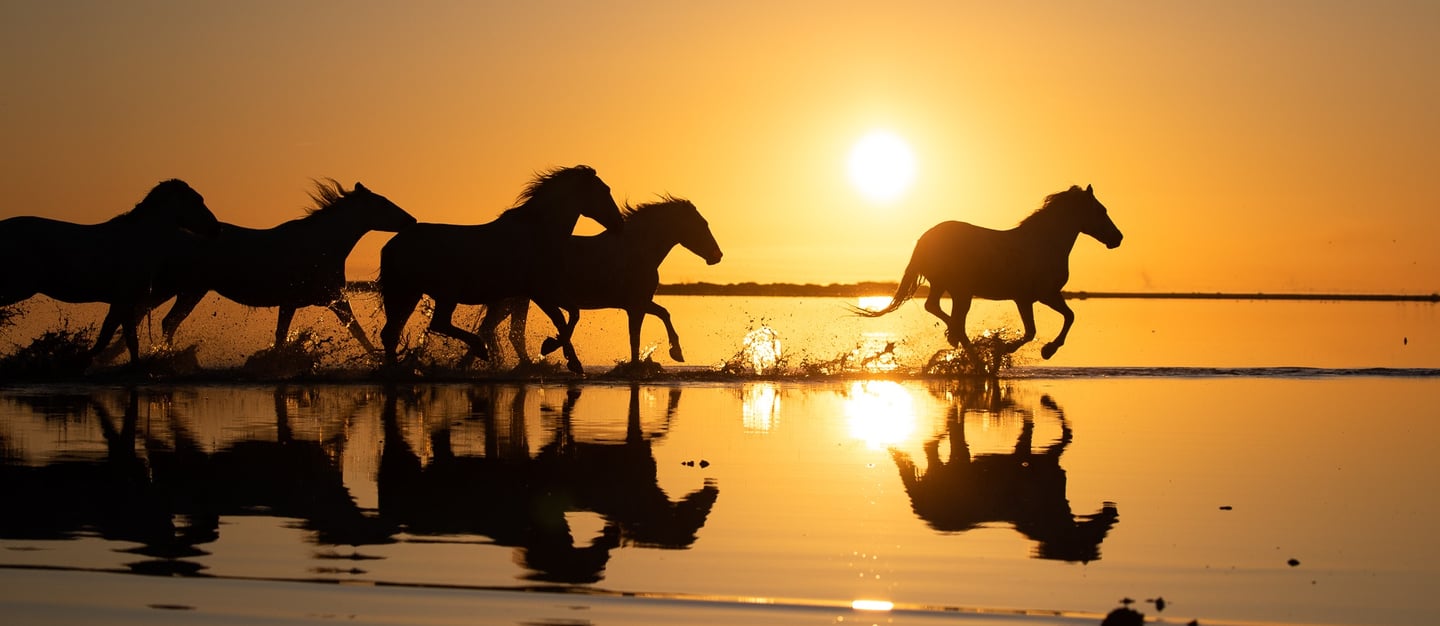
The golden hour (sunrise and sunset) : These moments offer a warm, soft light that enhances the horses' white coats and the surrounding landscapes. Sunsets, in particular, transform the sky into a palette of vibrant colors, creating dramatic, poetic backdrops for the horses' silhouettes.
Diffused light : Even on overcast days, the light often remains soft and enveloping, ideal for detailed portraits or more intimate scenes.
Diversified and Breathtaking natural Landscapes
The richness of the Camargue ecosystems offers a variety of natural settings which serve as backdrops for photographs :
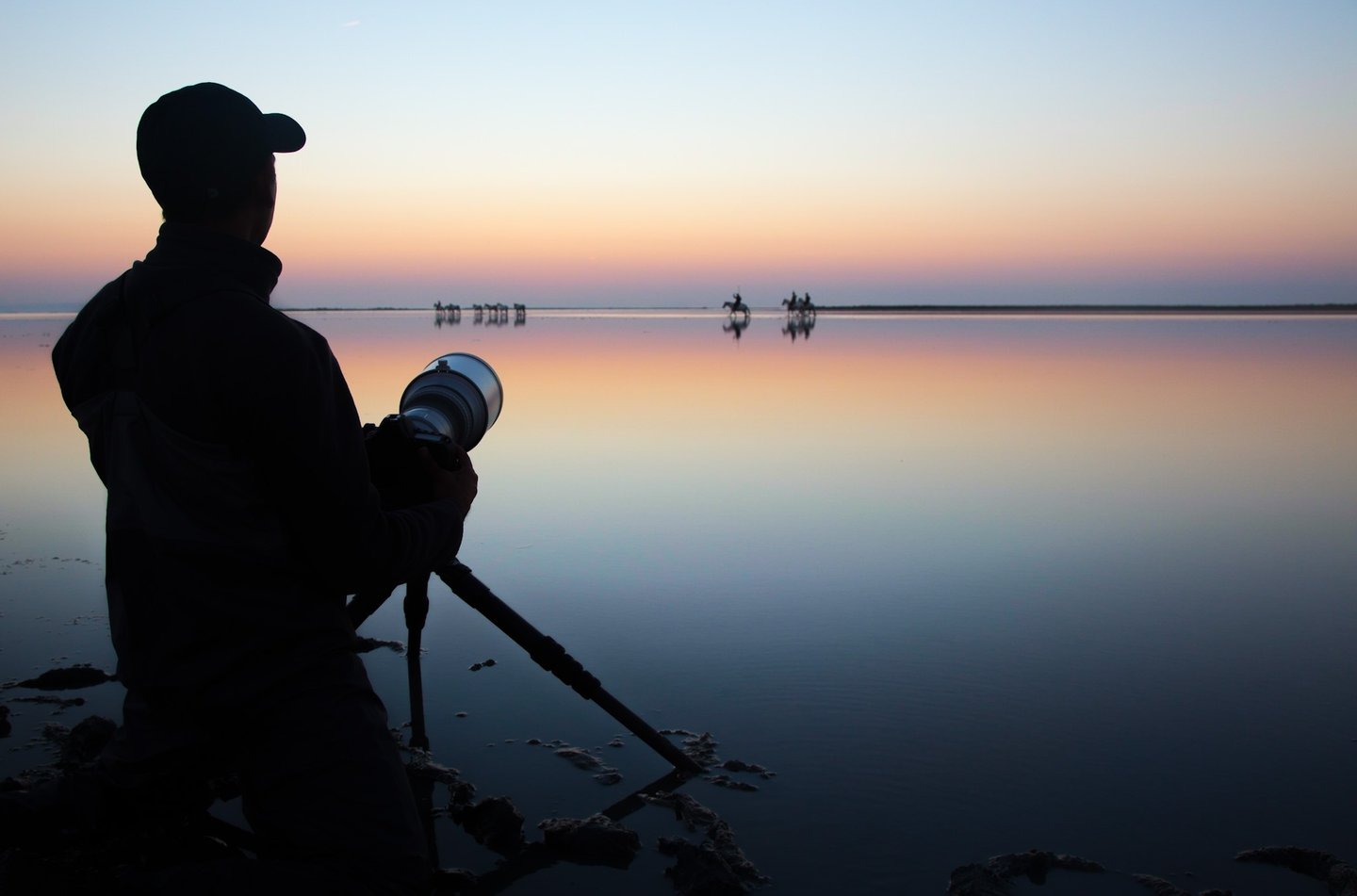
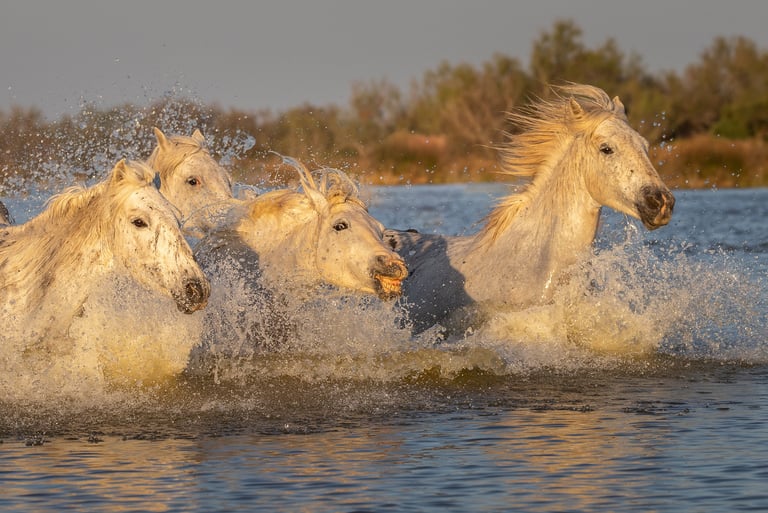
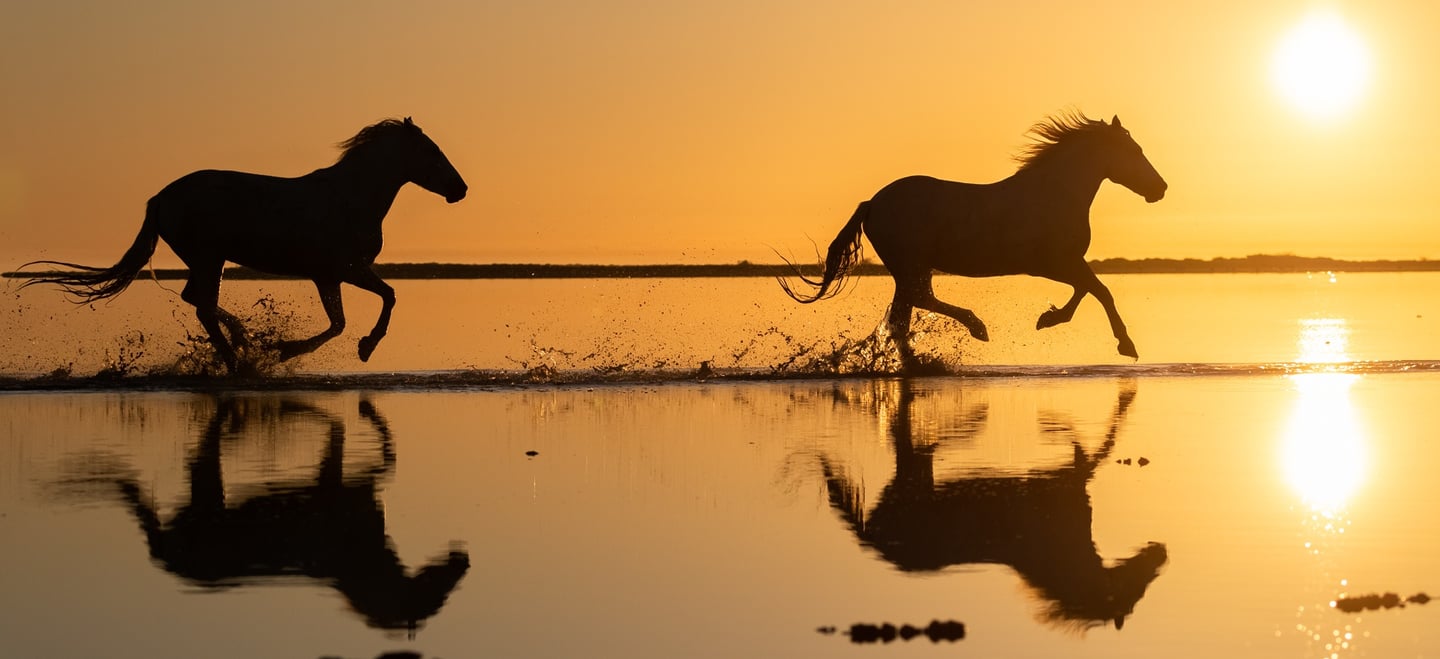
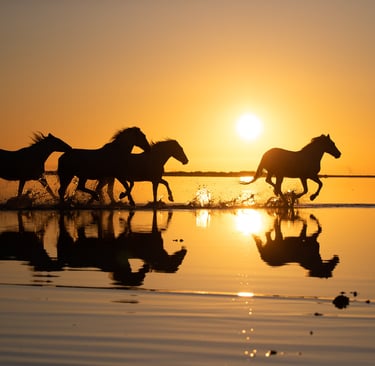
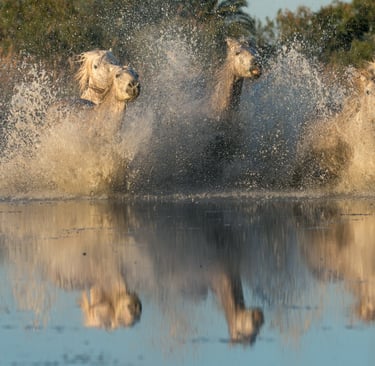
The Marshes : The vast expanses of shallow water, dotted with reeds and aquatic vegetation, are the horses' favorite playground. The scenes of horses galloping in the water, splashing the foam, are emblematic of the Camargue and offer dynamic and powerful shots. The reflections in the water add an extra dimension to the composition.
The Sea : The proximity of the Mediterranean allows you to photograph horses on sandy beaches, with the infinite horizon and waves in the background. These images evoke the freedom and raw power of equines.
The Dunes : The dune landscapes, with their specific vegetation and their gentle curves, offer an interesting contrast with the wetlands. They bring a different texture and perspective to photographic compositions.
It is worth noting that many locations in the Camargue are not freely accessible, as they are either regulated or privately owned.
It is advisable to obtain the necessary permits or to visit these sites accompanied by someone with access rights, such as during a photography workshop. However, some photographers choose to go on their own, often returning deeply disappointed because they are unable to photograph the horses under optimal conditions.
The unique Iconic Wildlife of the Camargue
In addition to its horses, the Camargue is home to a rich array of wildlife that enhances photographic opportunities :
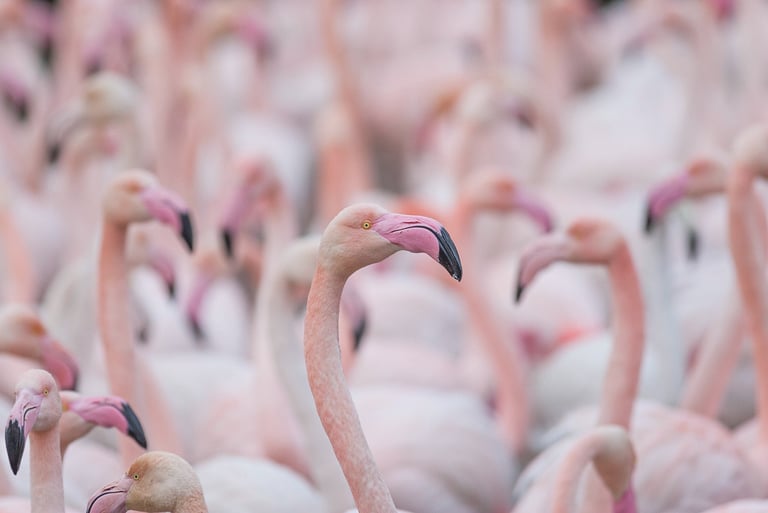
Greater Flamingos : These iconic birds, with their vibrant pink plumage, add a splash of color and an exotic touch to the landscape. Scenes featuring horses and flamingos coexisting in the marshes are highly sought-after and symbolize the region's unique biodiversity.
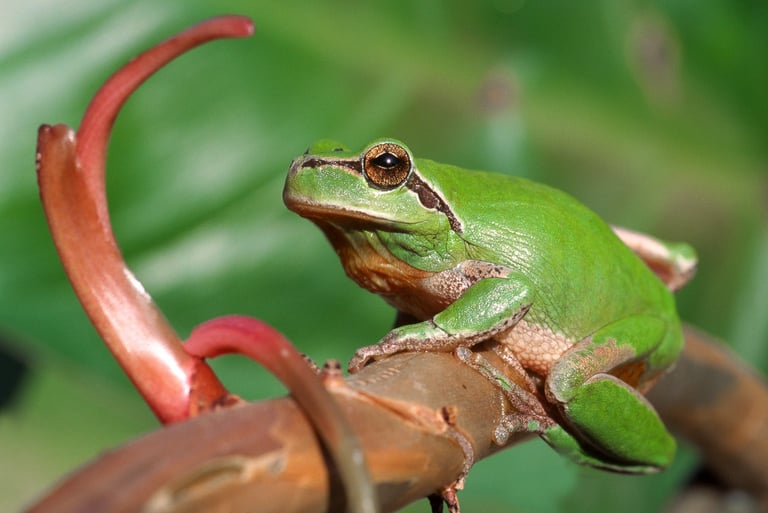
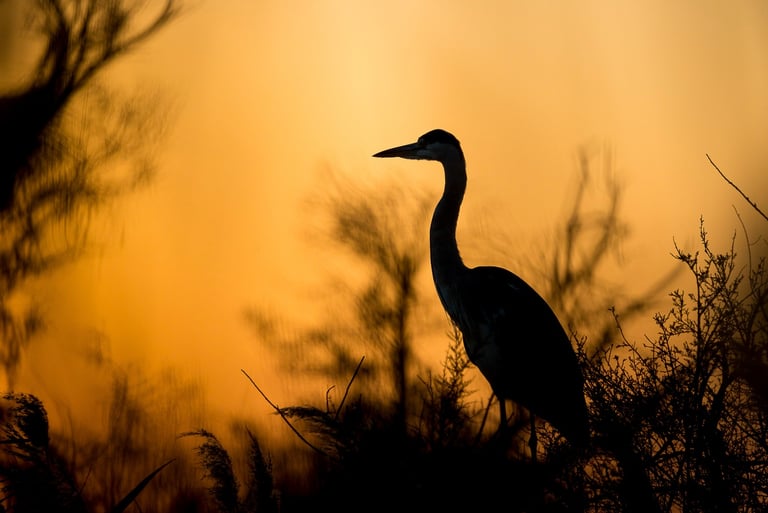
Other birds and animals : Herons, egrets, and numerous other migratory and resident bird species inhabit the marshes, offering opportunities for wildlife photography as well as red foxes, nutrias, tree frogs or wild boar among others.
The Gardians and Camargue Traditions
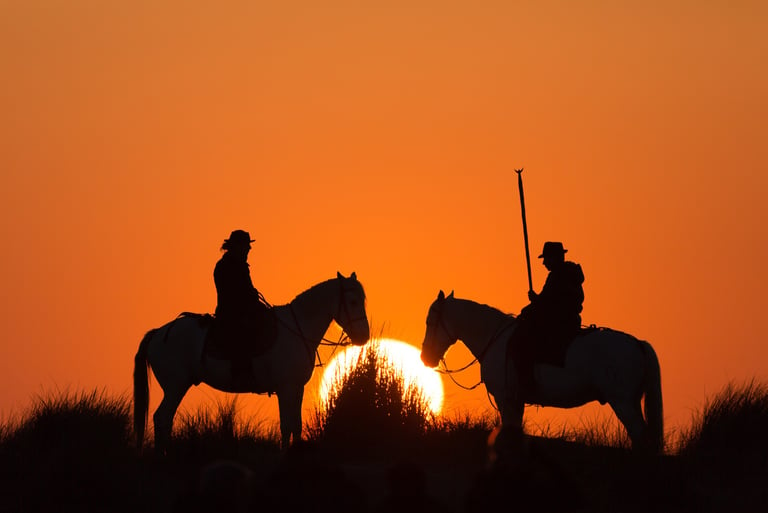
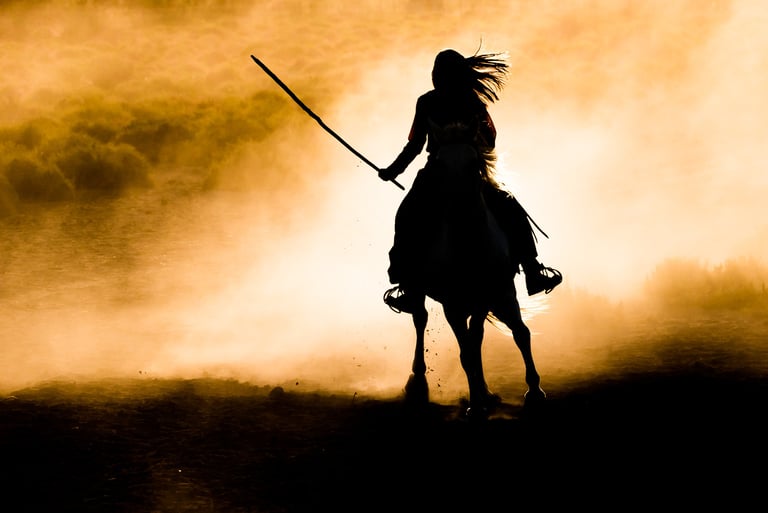
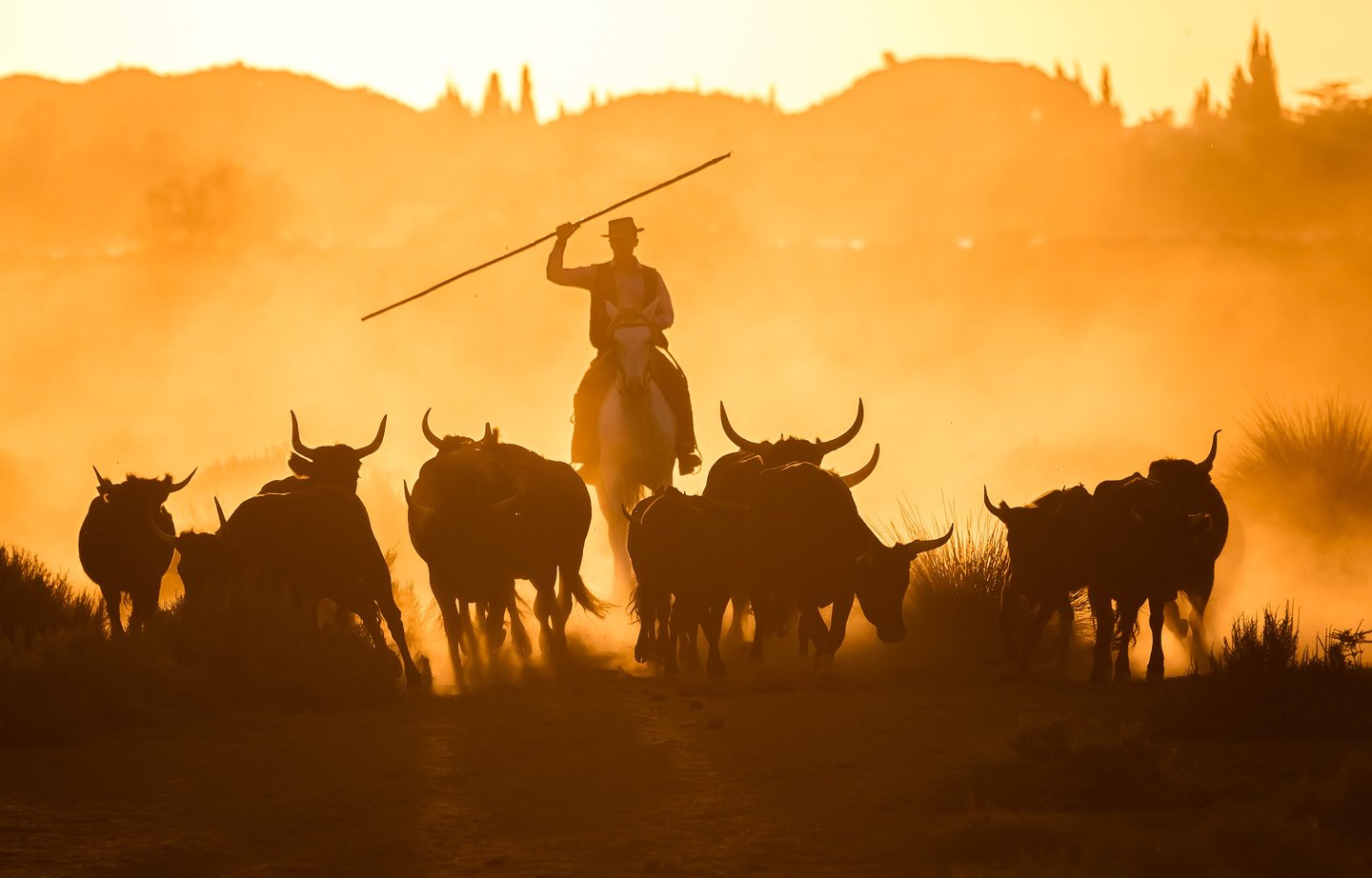
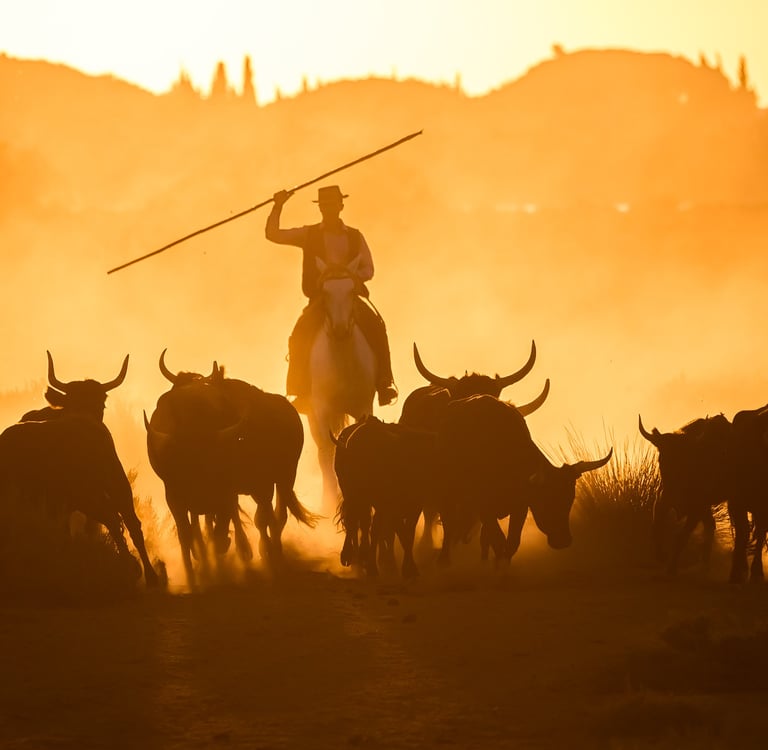
The presence of the Gardians, the cowboys of the Camargue, adds a unique human and cultural dimension to equestrian photography. Clad in traditional attire and armed with their tridents, they work alongside their horses to manage herds of bulls. These authentic working scenes, steeped in tradition and the bond between human and animal, are highly prized by photographers. They tell a story : that of an ancestral way of life and a living culture.
Unforgettable sunrises and sunsets
Sunrises and sunsets in the Camargue are legendary. The vast sky, the reflections on the water, and the silhouettes of horses and gardians create images of striking beauty. The warm, intense colors of twilight transform the landscape into a living painting, offering unique and memorable photographic opportunities.
In short, the Camargue offers an exceptional setting where natural beauty, wildlife, and human traditions converge to create unparalleled photographic opportunities, making it a dream destination for any equestrian photographer.
Optimal Seasons : Best Time to Photograph Camargue Horses
The Camargue is a dream destination for equestrian photographers, but the success of a photo shoot depends largely on the timing. Each season offers unique conditions regarding light, horse behavior, tourist crowds, and the general atmosphere. Understanding these variations is essential for capturing memorable images of the famous white horses.
Many professional photographers, including local figures like Patrice Aguilar, recognize the advantages of spring and autumn for photographing Camargue horses. These transitional seasons offer an optimal balance of weather conditions, light quality, and the overall environment :
Spring : Foals and Lush Landscapes
In spring, nature comes to life, offering lush green landscapes and the presence of young foals, which adds a touch of tenderness to the photos, and an excellent opportunity to capture touching moments between the little ones and their highly protective mothers. Spring is also characterized by a very nice light that is softer and less harsh than in summer. The sun sits at a lower angle, creating longer shadows and a more diffused, warm golden glow, especially during sunrise and sunset. This light enhances the horses' textures, forms, and movements without the stark contrasts typical of high summer.
Autumn : Dramatic Skies and Unique Ambiance
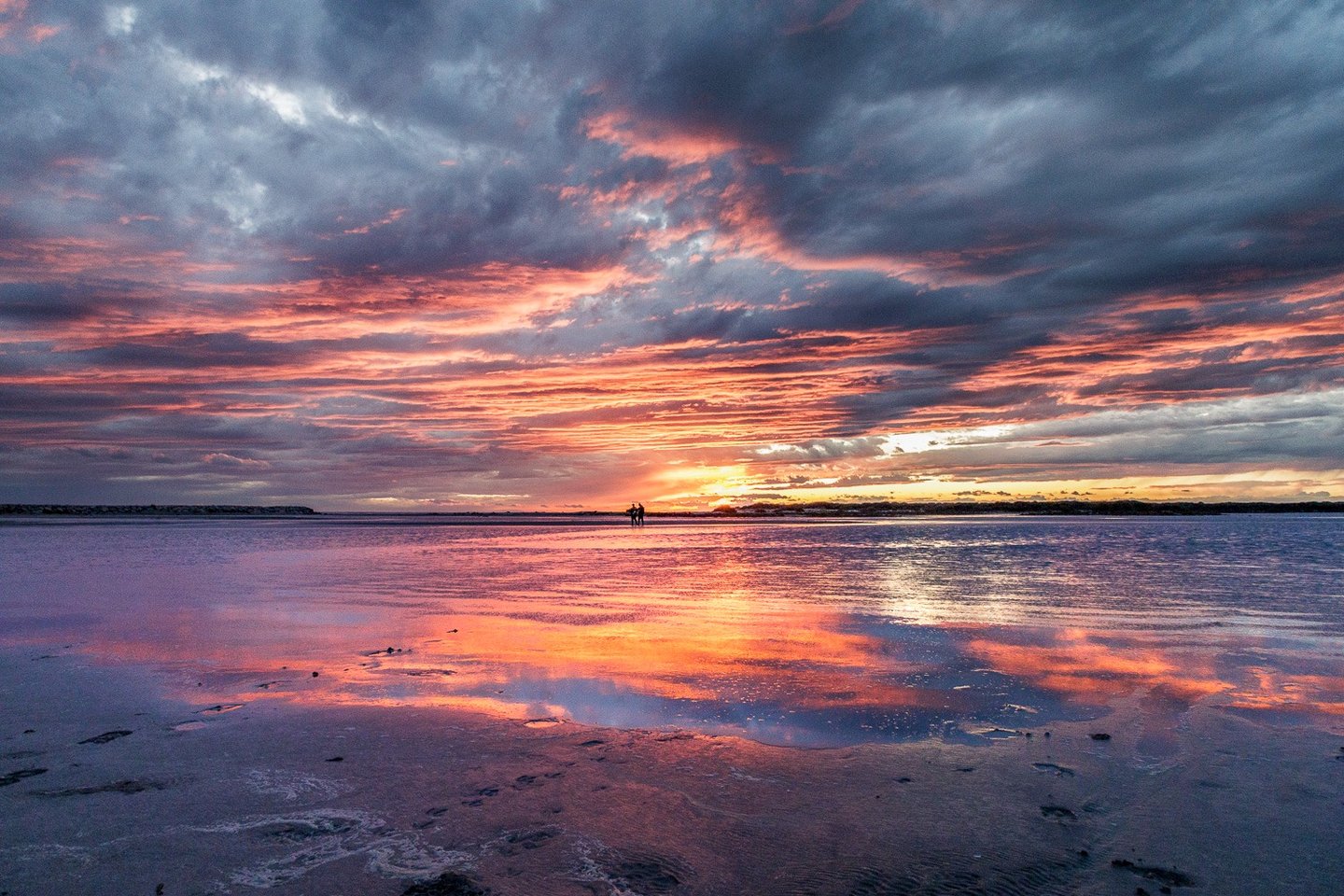
In autumn, the vegetation's warm colors and morning mists can create mysterious, epic atmospheres. The horses are also more active and dynamic, particularly during galloping sessions in the water, free from the lethargy that summer heat can induce. During fall, temperatures are generally milder, making long photo shoots more comfortable for both photographers and horses. Furthermore, the mosquito population, a major nuisance in summer, is significantly reduced during this season.
Both season are considered off-peak or shoulder touristic seasons, meaning fewer crowds. This allows photographers to work in a more serene atmosphere, undisturbed by tourists, and to capture purer, more authentic images of the horses in their natural habitat.
As an experienced local photographer, Patrice Aguilar frequently organizes photography workshops that schedule their sessions during spring and autumn, highlighting the importance of these times of year for capturing high-quality images of the horses and their interactions with the gardians. His expertise confirms that these seasons offer the best conditions for capturing the power, grace, and beauty of Camargue horses in their natural habitat.
In conclusion, while every season has its own charm, spring and autumn stand out as the ideal times for photographing Camargue horses, offering the best lighting conditions, a quieter environment, and more dynamic subjects.
Mastering Camargue Horse Behavior for Authentic Photography
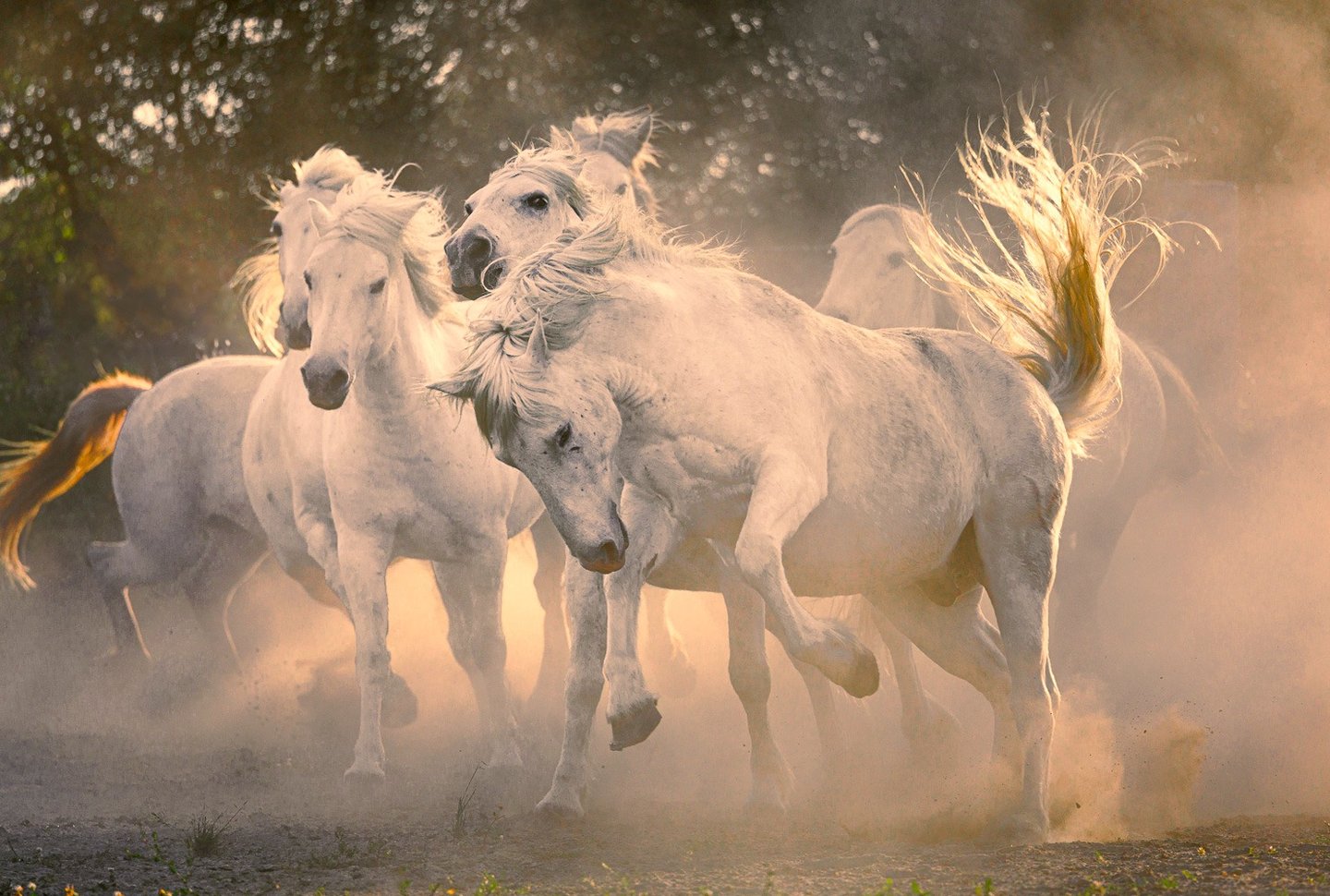
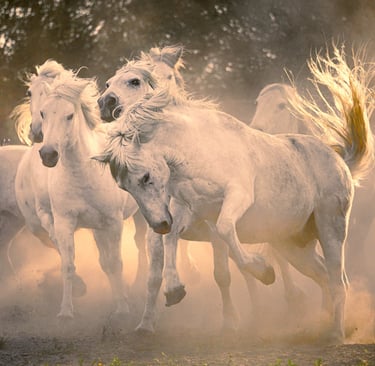
For equestrian photographers, a deep understanding of equine ethology is essential. It enables them not only to anticipate movements and interactions but also to capture the very essence of these majestic animals. Behaviors such as galloping, splashing, rearing, fighting, and running in a group are all rooted in their nature as prey animals and their social organization.
Why Horses Gallop and Run in Groups
The gallop is a horse's fastest gait and is intrinsically linked to its survival instinct as a prey animal. In the wild, flight is the primary line of defense against predators. Running at high speed allows for a quick escape from a perceived threat.
Horses often run in groups for several reasons :
• Safety in Numbers (Dilution Effect) : A large group offers better protection against predators. The more individuals there are, the lower the probability that any specific horse will be the target of an attack.
• Heightened Vigilance : In a group, there are more eyes and ears to detect potential dangers. Each member of the group contributes to collective vigilance.
• Social Cohesion : Group galloping strengthens social bonds and the hierarchy within the herd. It is also a form of play, especially among young horses, that allows them to develop their physical and social skills.
• Leadership: Although the decision to move is not always initiated by a single individual, the group often follows a leader who guides the others in a change of activity, such as moving to new pastures or escaping danger.
Why Horses Splash
Splashing is often a direct result of galloping through water, a behavior particularly characteristic of Camargue horses in their marshlands. It is not an intentional act in itself, but rather a byproduct of their rapid movement through shallow water. However, horses may also splash out of playfulness, especially younger ones, or to cool off in hot weather. Scenes of horses splashing are highly sought after in photography for their dynamism and aesthetic appeal.
Why Horses Rear
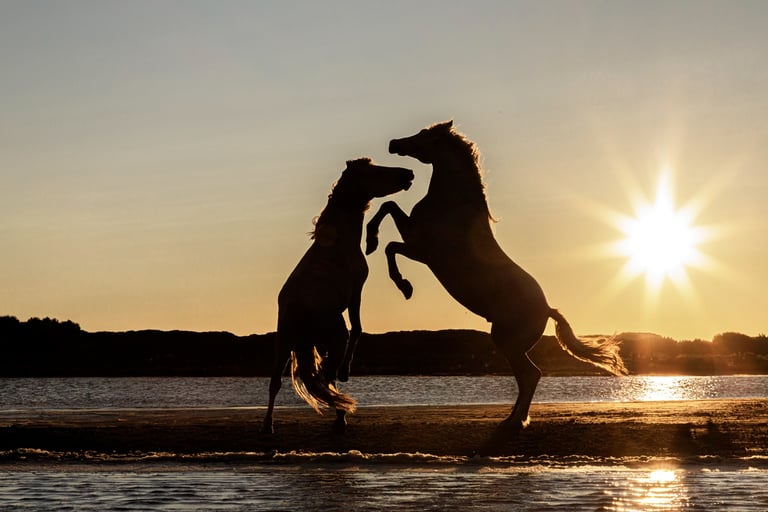
Rearing is a behavior in which a horse rises up onto its hind legs. It can have several meanings :
Defense or Fear : This is a powerful defensive reaction. A horse may rear if it feels threatened or trapped, or if it perceives imminent danger. It serves as a form of intimidation or a way to break free from restraint.
Refusal or Frustration : A horse may rear to refuse a request it does not understand or deems excessive, or if it is experiencing pain or discomfort (for example, due to ill-fitting tack).
Excitement or Play : In young horses or during play, rearing can be an expression of energy and high spirits. Stallions may also rear during displays or confrontations.
Pain : Physical pain, particularly in the back, hips, or limbs, can trigger rearing as a reaction to discomfort.
Why Horses Fight
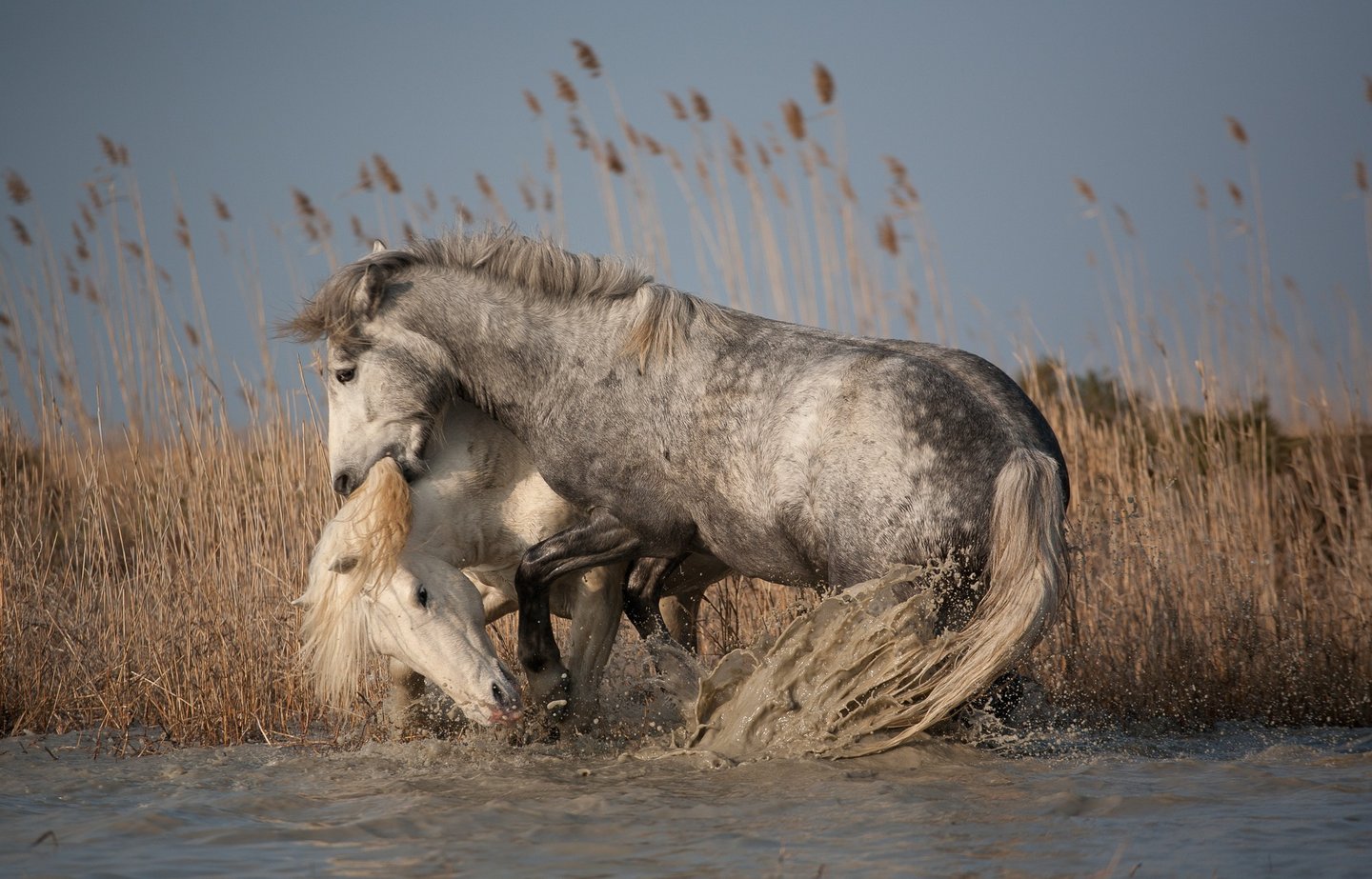
Fights between horses, while less frequent in a stable group, are important interactions for establishing and maintaining social hierarchy. They can manifest as biting, kicking, bucking, and charging.
Establishing Hierarchy : Within a herd, horses establish a dominance hierarchy to regulate access to resources (food, water, mates) and ensure group stability. Confrontations are more frequent when a new group is forming or when new individuals are introduced.
Defending Territory or Mares : Stallions, in particular, may fight to defend their territory or to gain access to mares in heat.
Play : Among young horses, mock fighting is part of social play and is essential for developing physical and social skills.
Stress or Confinement : Aggressive behaviors can be exacerbated in confined or stressful environments.
It is important to note that once the hierarchy is established, aggressive interactions become more subtle, manifesting as discreet threats (pinned ears, body positioning) rather than outright fighting, in order to minimize the risk of injury within the group.
Understanding these dynamics allows Camargue photographers to anticipate key moments and capture images that tell a deeper story about the lives of these fascinating animals.
Essential Photography Gear for Capturing Camargue Horses
Photographing Camargue horses galloping through the marshes at sunrise or dusk is an unforgettable experience for any wildlife photographer. However, this wet, salty, and often dusty environment, combined with the speed of the subjects, imposes specific equipment requirements.
This guide helps you choose your gear, organized by expertise level and broken down by the categories of accessories essential for tackling the conditions of the Camargue.
Recommended Camera Bodies for Camargue Photography
Photographing horses in motion requires, above all, a responsive camera body with a capable autofocus (AF) system and a sufficient continuous shooting speed. Mirrorless cameras are currently recommended for their lightweight design, silent mode, and automatic animal eye detection.
Beginner
An APS-C camera body is ideal for getting started without breaking the bank. It offers a good balance of weight and price, along with a crop factor that helps "bring subjects closer."
Recommended models : Canon EOS R10, Nikon Z50 II, Sony A7 III, Panasonic Lumix DC-G100.
Advantages : Lightweight, high-performance burst shooting (up to 15 fps for the R10), modern autofocus with animal detection.
Limitations : Lower performance in low light (dawn/dusk).
Enthusiast
The serious enthusiast will look for a high-end APS-C body or an affordable full-frame model, offering better high-ISO performance and a more robust build capable of withstanding sea spray.
Recommended models : Canon EOS R7 (the king of APS-C wildlife photography with its 30 fps), Sony Alpha 7 III, Nikon Z6 III.
Advantages : In-body image stabilization, weather sealing (dust and moisture resistance), excellent digital noise management.
Limitations : Full-frame models require longer and heavier lenses.
Professional
Professionals require absolute reliability, impeccable image quality, and an autofocus system capable of locking onto a galloping horse in extreme lighting conditions.
Recommended models : Sony Alpha 1 II, Sony A9 III, Nikon Z8, Canon EOS R5 II or R1.
Advantages : Extreme burst speeds with no viewfinder blackout, formidable AF tracking, maximum weather sealing, and high dynamic range.
Limitations : Very high cost and greater bulk.
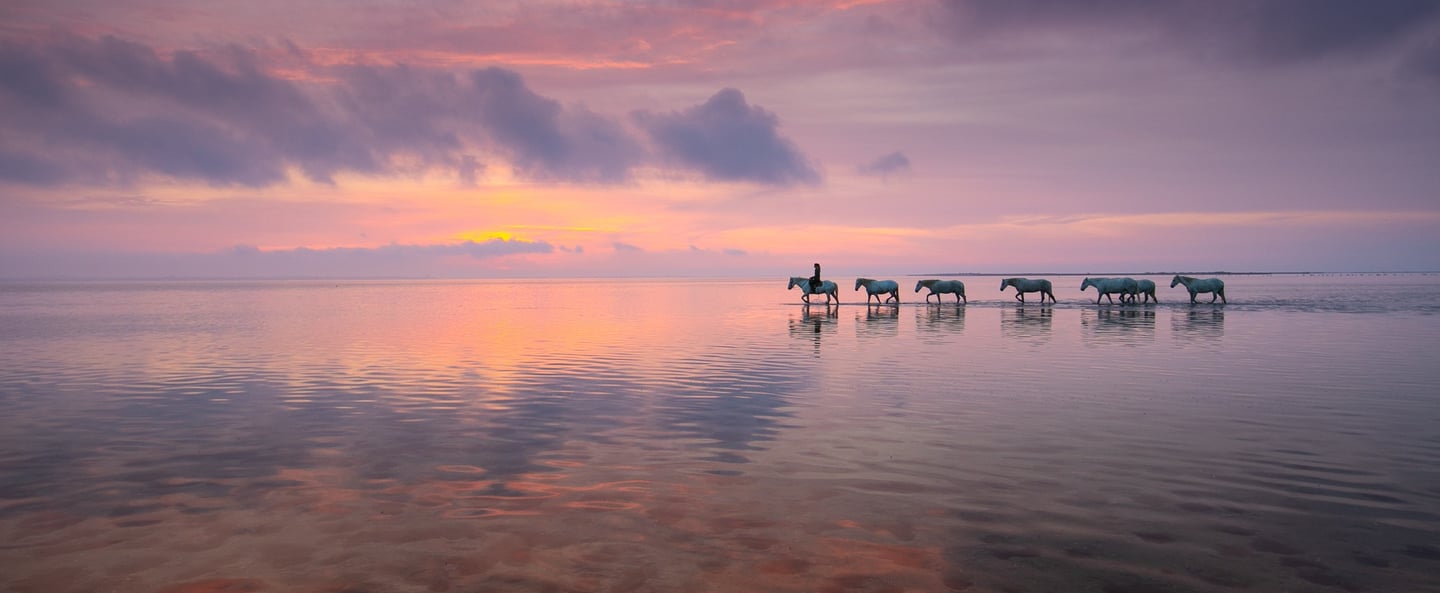
The Best Lenses for Action & Portrait Shots
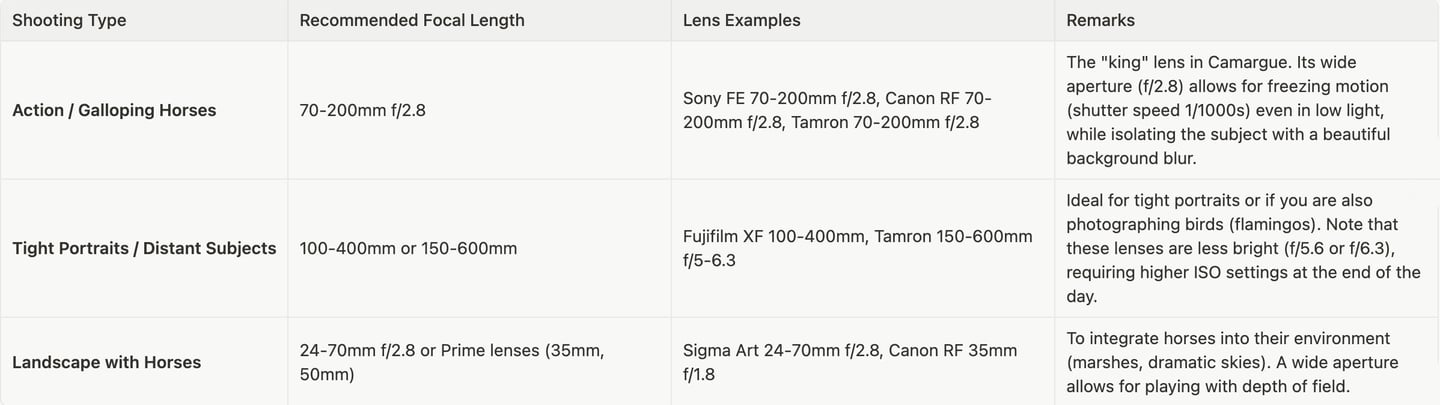
The need to maintain a safe distance from the (often unpredictable) horses, combined with the vast open spaces of the Camargue, makes telephoto lenses essential. Lens aperture is crucial, as the best photos are often taken early in the morning or late in the evening when light levels are low.
Tip: Avoid changing lenses in the field to prevent sand or salty spray from entering your camera body. Bring two bodies if you can !

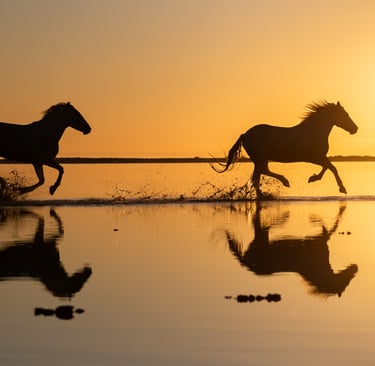
High-Speed Memory Cards : Don't Miss the Shot
Wildlife photography, and capturing galloping horses in particular, relies heavily on burst shooting. For your camera to fire off a rapid sequence of shots without slowing down, the speed of your memory card is absolutely critical.
The role of the buffer and write speed
When shooting in burst mode, images are first temporarily stored in the camera's internal memory buffer. Only then are they transferred to the memory card. If the card isn't fast enough, the buffer fills up quickly, forcing the camera to slow down, or even stop the burst, while waiting for the card to clear the buffer.
In wildlife photography, where every fraction of a second counts, a buffer that clears quickly is essential to avoid missing the decisive moment.
CFexpress Type B cards (offering speeds of up to 1,700 MB/s and beyond) enable ultra-fast continuous shooting (20 fps and up) and 4K/8K video recording with professional cameras. They are the standard for high-end cameras and are essential for fully leveraging the performance of the latest mirrorless cameras.
Capacity : For RAW files (which are larger), opt for cards with a minimum capacity of 64 GB to 128 GB. It is often better to use several medium-capacity cards rather than a single very large one to minimize the risk of data loss.
Reliability : Choose well-known brands (SanDisk, Lexar, Sony, ProGrade Digital) for their reliability and durability.
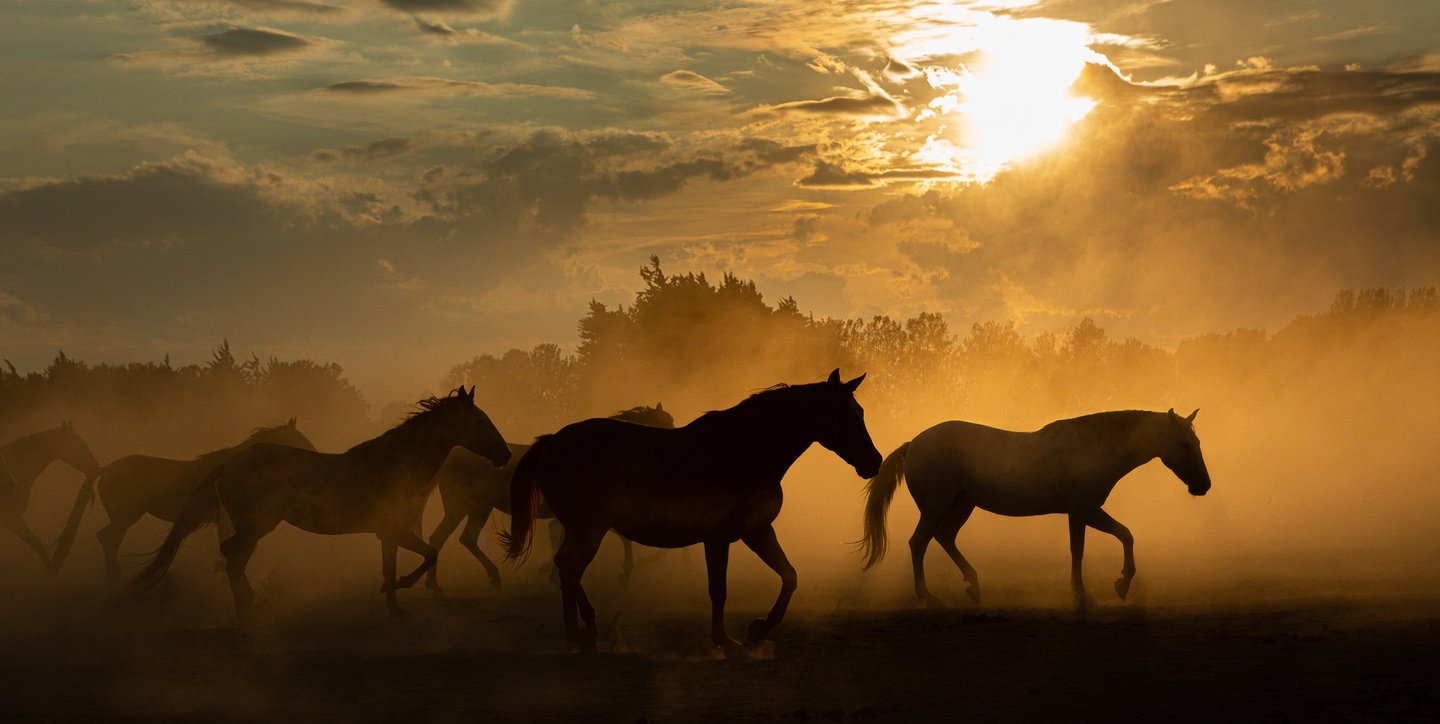
Modern cameras are power-hungry, so remember to bring more than one battery
Wildlife and action photography is very power-intensive, especially with mirrorless cameras (due to the electronic viewfinder, high-speed continuous shooting, image stabilization, and continuous autofocus/AF-C or AiServo).
Quantity : Bring a minimum of three batteries per day of shooting. Horses in action offer little downtime.
Organization : Use numbered stickers (1, 2, 3...) on your batteries to ensure even rotation (equalizing wear) and to easily distinguish between full and empty ones.
Battery Grip : Using a battery grip is highly recommended. It allows you to use two batteries simultaneously and provides a better grip for vertical-format shots (portrait orientation).
Cold Weather : If you are shooting early in the morning during spring or autumn, keep your spare batteries close to your body (e.g., in an inner pocket) to preserve their charge.
Protecting Your Gear : Rain, Mud, Salt & Sand
In the Camargue, the danger to your gear comes not only from the rain but, more importantly, from saltwater spray and mud kicked up by horses' hooves.
Protective Covers (Rain Covers)
It is essential to protect the camera body and lens combination. Makeshift plastic bags should be avoided when dealing with saltwater.
High-end (Professional) : Think Tank Hydrophobia. Made from 3-layer nylon (Gore-Tex style) with sealed seams, these feature a strap and a front lens element cover. They require the purchase of a specific eyepiece for your camera body.
Mid-range (Amateur) : Think Tank Emergency Rain Cover or LensCoat RainCoat. Very compact, they fit into any bag and deploy quickly by attaching to the camera's hot shoe.
Entry-level (Beginner) : Vortex Media Pro Storm Jacket. A simple tubular design with elastic cords; sufficient for protection against splashes.
Essential maintenance accessories
Lens hood : Never remove it ! In addition to preventing lens flare, it serves as your first line of physical defense against water and mud splashing onto the front element.
Microfiber cloths : Bring several, kept in waterproof bags (like Ziploc bags). Saltwater dries quickly and leaves marks that are difficult to remove.
Eyeglass wipes : Very handy for quickly and effectively cleaning the front element between horse passes.
UV filter/Protector : If you are using a very expensive lens (e.g., 70-200mm f/2.8), screwing a high-quality neutral filter onto the front element helps protect it from scratches caused by sand or repeated mud cleaning.
Essential Photographer's Attire & Personal Protection
Beyond your camera gear, your own comfort and protection are essential to fully enjoy your photography tour in the Camargue and avoid environmental discomforts.
Clothing
Waterproof, windproof jacket : Essential for cool mornings, windy evenings (Mistral), and sudden rain. Opt for breathable materials to avoid overheating.
Long, light-colored clothing : Even in hot weather, light-colored trousers and long sleeves are recommended. They provide sun protection and are less attractive to mosquitoes.
Layered clothing : Temperatures can change rapidly between sunrise and midday. Adapt by wearing layers that are easy to put on or take off.
Waders
To photograph Camargue horses, you will often need to step into the water of marshes or ponds to get low-angle shots or position yourself in their path.
You can choose between boots, thigh-high waders, and chest waders depending on how deeply you intend to immerse yourself; however, chest waders are by far the most practical option, as they protect your clothes from mud and dust and also provide good protection against mosquito bites.
Sun Protection
Hat or cap : To protect your face and neck from the intense Camargue sun.
Sunglasses : For visual comfort and UV protection, especially given the glare off the water.
Sunscreen : Apply generously to all exposed areas of skin, even on cloudy days.
Insect Protection
Mosquitoes can be abundant in the Camargue, especially at sunrise and sunset, and can make the experience very unpleasant.
Mosquito repellent : An effective product is absolutely essential. Apply it to exposed skin and your clothing.
Face/head net : For times when mosquitoes are particularly aggressive, a net worn over a hat can be a lifesaver, allowing you to focus on your photography.
Anti-mosquito clothing : Certain garments are treated or designed with a tight weave to prevent bites.
I hope this guide proves useful. If you follow all these tips, your time with the Camargue horses will be unforgettable, and you will return home with memory cards and a mind filled with stunning images.
And finally, most importantly : have fun and enjoy your stay in the Camargue !!!
Elevate Your Photography : Exclusive Camargue Horse Workshops with Patrice Aguilar
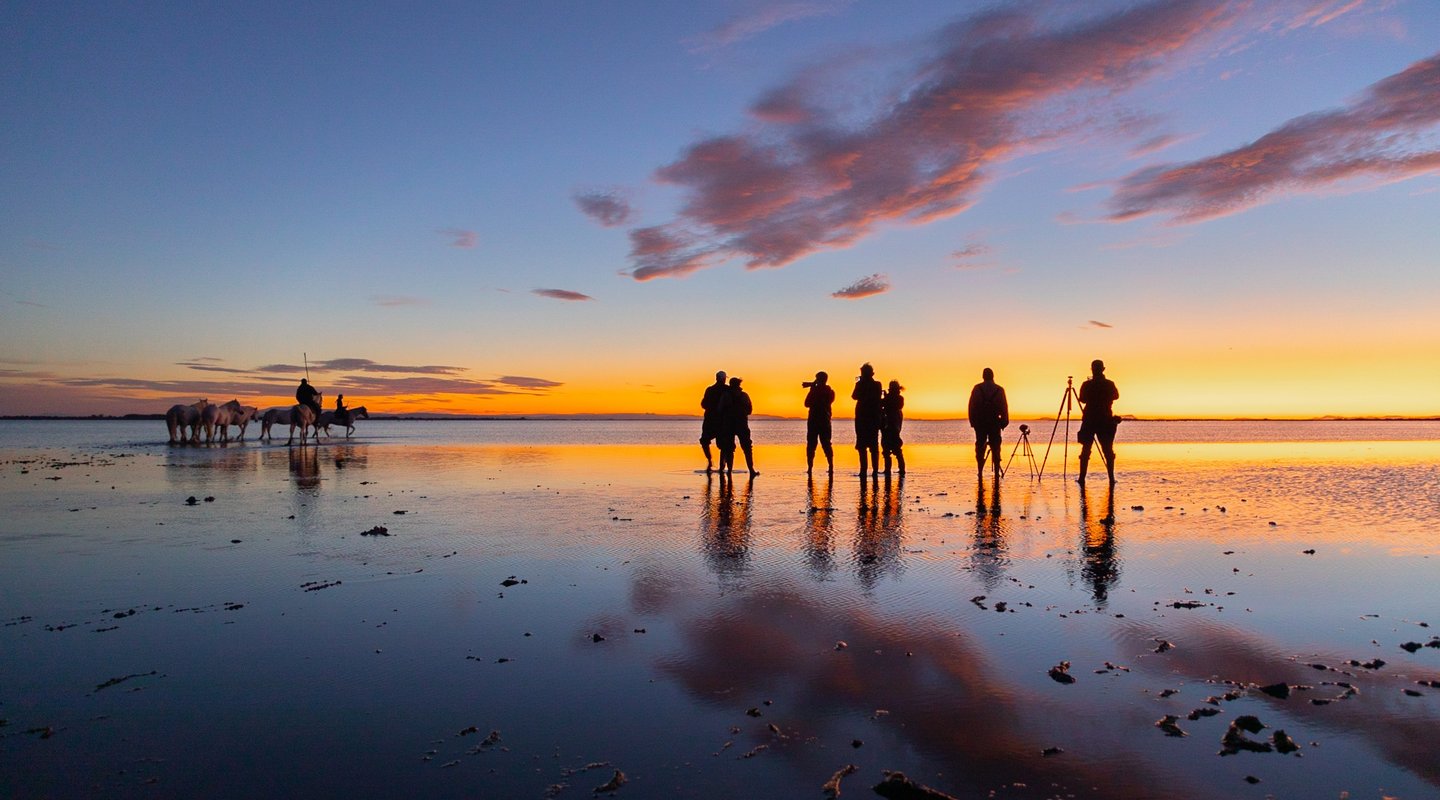
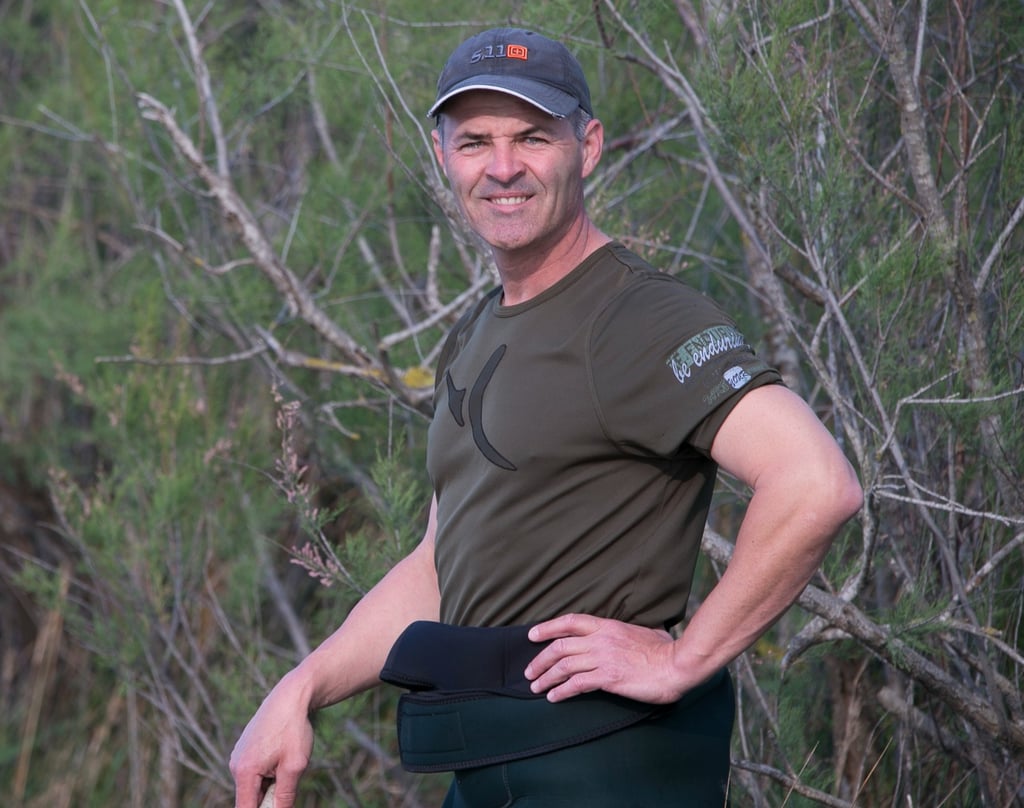
Beyond the equipment, it is expertise, local knowledge, and privileged access that transform a simple photograph into a work of art. This is precisely what a workshop with Patrice Aguilar, a professional photographer whose passion for the Camargue spans over 25 years, offers you.
25 years of expertise at your service
With a quarter of a century spent traversing the marshes, Patrice Aguilar does more than just know the region, he lives it. His intimate understanding of horse behavior and the nuances of this unique ecosystem is an invaluable asset. He knows exactly where and when to position himself to capture that magical moment, whether it is a wild gallop at sunrise or an intimate portrait in the golden evening light. His guidance, tailored to your skill level, will enable you to master wildlife photography techniques and make the most of your equipment.
Exclusive Access and Private Locations
What truly sets Patrice’s workshops apart is the network of relationships he has cultivated over decades. Thanks to strong friendships and mutual trust with the manadiers (bull and horse breeders), Patrice opens doors to private locations and exclusive areas inaccessible to the general public. These key partners understand exactly what photographers are looking for and orchestrate authentic, spectacular scenes, ensuring unique photo opportunities while honoring Camargue traditions.
Upcoming workshops in the Camargue
You can click on the links below for more informations regarding the upcoming workshops in November 2026 & March 2027 or contact me directly by email at : contact@pixterra.fr
Testimonials
They took part in a Camargue horse photography workshop with Patrice, and here is what they thought of it
Lisa Moore ⭐️⭐️⭐️⭐️⭐️ (USA)
2 months ago
I signed up for this intensive workshop for the opportunity to photograph horses running on the beach and stallions play-fighting each other. Our group came away with hundreds of amazing images but what really sticks with me is the experience of getting to know the horses over the course of the week.
We had one afternoon with my favorite herd that included a mare and her 2-3 month old foal. The interaction was priceless ! Patrice has perfected his horse photography with these amazing creatures for many years and his expertise (and patience) is legendary.
You won't find a better guide to lead you through the experience of the White Horses of the Camargue. I hope to have an occasion to come back for another week soon.
Bonnie forrest ⭐️⭐️⭐️⭐️⭐️ (USA)
2 months ago
I’ve attended many photography workshops over the years, and this experience was truly exceptional. Patrice has a rare ability to meet each participant exactly where they are, whether you’re just starting out or have been shooting for years.
What stood out most is his approach: never intrusive, always available. If you want space to explore, he gives it. If you’re ready to push your skills further, his guidance is precise, thoughtful, and immediately impactful.
The entire week felt thoughtfully curated, from our gracious and welcoming hosts at the hotel to the rhythm of the morning and afternoon shoots.
Unlike anything else I’ve attended, and an experience that meaningfully elevated my photography.
Bernard Crampon ⭐️⭐️⭐️⭐️⭐️ (SPAIN)
2 months ago
Patrice Aguilar is not only a great professional photographer with over 25 years of experience photographing horses and their environment, but also someone who will share his knowledge with you when you need it most. It's also important to highlight Patrice's flexibility during photo sessions, for example, by changing locations in case of inclement weather.
This is thanks to his personal relationships with the ranchers who rent us the horses for the photo shoots. Patrice is also excellent in terms of organization, outside of photography.
He's attentive to every detail and always willing to help.
We could also mention his cheerful nature. I've known Patrice for many years, and I never tire of returning to the Camargue with him.
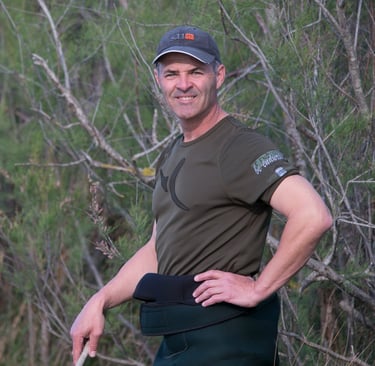
LOOKING FORWARD TO SEEING YOU VERY SOON IN THE CAMARGUE !!!
Fine art prints and photography workshops.
EURL PIXTERRA
contact@pixterra.com
+33 6 87 22 56 40
© 2026. All rights reserved.
Patrice Aguilar
Impasse du vieux pin
13180 Gignac la Nerthe
France


CONTACT